>
>Subject: Re: OT: Tube Audio
> From: Scott Stevens <chenmel at earthlink.net>
> Date: Thu, 20 Oct 2005 07:40:01 -0500
> To: "General Discussion: On-Topic and Off-Topic Posts" <cctalk at classiccmp.org>
>
>On Thu, 20 Oct 2005 07:57:58 -0400
>Allison <ajp166 at bellatlantic.net> wrote:
>
>> >
>> >Subject: Re: OT: Tube Audio
>> > From: "Chuck Guzis" <cclist at sydex.com>
>> > Date: Wed, 19 Oct 2005 23:08:47 -0700
>> > To: cctalk at classiccmp.org
>> >
>> >On 10/19/2005 at 10:19 PM Zane H. Healy wrote:
>> >
>> >>OK, since there seem to be a fair amount of people into Tube audio,
>> >>or at least with a knowledge of it. Would someone care to explain
>> >>the following to someone that is used to an all in one unit such as a
>> >>Sony Receiver. What is the purpose of separate Amp and Pre-Amps. I
>> >>think I understand the whole phono pre-stage, but I've yet to find a
>> >>decent explanation of the rest, and I'm looking to switch to tubes
>> >>for playback of records (primarily Vinyl, but I'm also interested in
>> >>78's).
>> >
>> >Purely from memory, but I believe one generally used a separate pre-amp
>> >mostly due to hum issues. The power supply for the preamp could make use
>> >of lower plate voltages, better regulation and DC heater supplies.
>> >
>> >Or so I think I recall.
>> >
>> >Cheers,
>> >Chuck
>> >
>>
>> No. Gads, creating answers revisionistically. Rare back then was a preamp
>> with DC heaters. Besides without the oxygen free stabilized cables how
>> could you appreciate it. ;)
>>
>My Dynaco preamp is from the early 60's and has a filtered DC power supply section for the heater filaments.
>
I didn't say nonexistant, only rare. Dynaco was amoung the best then.
The alternate was a filiment that was balanced to ground to minimize
the amplitude of AC heater to cathode coupling, also only seen on
quality gear.
Allison
> (1600 bpi), and some report a few hundred records of 16384, then a few
> at a smaller number, then more at 16384, etc. I'd think there were
> some read problems, but the tape wasn't shoe-shining
Are the "smaller sized" records 80 bytes, and have tape marks
near them? If so, these are the ANSI tape labels for volume start/end
and saveset start/end.
Even though you mount VMS BACKUP tapes /FOREIGN on
a VMS system, they still have ANSI labels on them.
If there are truly damaged records then the redundancy blocks
(unless you turned them off) will help you.
Tim.
>
>Subject: Re: OT: Tube Audio
> From: "Chuck Guzis" <cclist at sydex.com>
> Date: Wed, 19 Oct 2005 23:08:47 -0700
> To: cctalk at classiccmp.org
>
>On 10/19/2005 at 10:19 PM Zane H. Healy wrote:
>
>>OK, since there seem to be a fair amount of people into Tube audio,
>>or at least with a knowledge of it. Would someone care to explain
>>the following to someone that is used to an all in one unit such as a
>>Sony Receiver. What is the purpose of separate Amp and Pre-Amps. I
>>think I understand the whole phono pre-stage, but I've yet to find a
>>decent explanation of the rest, and I'm looking to switch to tubes
>>for playback of records (primarily Vinyl, but I'm also interested in
>>78's).
>
>Purely from memory, but I believe one generally used a separate pre-amp
>mostly due to hum issues. The power supply for the preamp could make use
>of lower plate voltages, better regulation and DC heater supplies.
>
>Or so I think I recall.
>
>Cheers,
>Chuck
>
No. Gads, creating answers revisionistically. Rare back then was a preamp
with DC heaters. Besides without the oxygen free stabilized cables how
could you appreciate it. ;)
The same preamp could be used with different power amps. Also
Not all preamps were the same depending on the source used
(mag cart, moving coil or variable reluctance or even ceramic)
and the response curve requred. Many amps contained the required
preamp, some didn't. Generally the larger ones didn't due to size.
As the stereo system could have the preamps, volume and tone controlls
for user convenience and the power amp (the large, heavy and hot)
located elsewhere. Back in the 60s I knew a few people that were
into serious audio and the power amp was in the basement, it produced
too much heat, large and was ugly. Back then a good FM (maybe even stereo)
reciever was often seperate as well.
Component audio was that way.
Just like component computers.
Allison
On Oct 19 2005, 7:49, Joe Abbott wrote:
> Sooo... If anyone has a Cromemco SCC board with ROMs,
> please check them to see if they are the MCB-216 roms.
> There were two 2716 roms in sockets 0 and 1 containing
> a monitor program and 3k control basic. We need an
> image of these roms or a text hex/decimal/octal
> listing would suffice (anything machine or human
> readable as long as it's accurate and complete).
>
> Pete T. and Randy M. on the list were also looking for
> these.
Yes. I have an SCC but not with those ROMs, and my attempts to find
the MCB-216 ROMs have met with no more success than Joe's.
--
Pete Peter Turnbull
Network Manager
University of York
At 12:00 -0500 10/17/05, woodelf wrote:
>Are we tallking real gates as in TTL, or FPGA style design? Forth does
>have several advantages
>over say fortran since they removed the Sense Switch requirment of
>fortran.My worry is that you
>may not be able to high-level threshold logic and memory anymore for
>industral problems.
Either TTL, or in 20 years, whatever the then-current version
of FPGA or ASIC is. (To tell the truth, I had in mind re-creating the
Harris RTX2010, but that's just me.) The point is, creating from
scratch and then verifying a system (hardware, OS, software) to run
FORTH reliably would be far easier than the same task for FORTRAN or
JAVA, and in 20 years, that may be the path you'd choose to take.
I am depressed at how difficult it has become for any one
person to really understand either all of the hardware or all of the
software (let alone both) in any commodity system, whether controller
or desktop. Two more decades in that direction, and who'll know
*what* is "under the hood"? Viruses, mal-ware in distribution CD's,
Pentium floating-point multiply bugs, cache sync errors, my personal
favorite - a compiler that forgot to save the contents of its
floating-point registers when it got an interrupt in the middle of a
calculation - and so on .... That stuff will all affect "emulators"
too. So if your application is mission-critical, you may want/need to
re-build the platform system from scratch. Better a simple set of
system requirements (a la FORTH) if that's where you end up going.
--
- Mark
210-522-6025, temporary cell 240-375-2995
On Oct 17 2005, 10:50, Bert Thomas wrote:
> Doc Shipley wrote:
> > Check this out:
> >
> > http://venhaus1.com/airsine.html
> >
> > US$700 power cable. I'm not kidding.
>
> What kind of people believe in this crap?
> Do they replace the wiring in their house as well to prevent
> micro-movements of the wires?
> And after that the cable that delivers electricity to their house?
> Or are they generating their own "clean" current with special
generators
> wounded with golden wires?
> Hmmm, with some fantansy I can create a whole new market.
One of my cow orkers, Marc, has pointed out that some of it's been done
before:
http://www.belt.demon.co.uk/
For those who don't want to wade through the drivel, Marc sums it up
thus:
"Stuff like ensuring all books in the listening room have to
have an odd number of pages, sticking bits of foil here there
and everywhere...the web site reads like some weird cult, but
he made a lot of money from it, so who's the fool ??"
--
Pete Peter Turnbull
Network Manager
University of York
>
>Subject: Re: Computer speedometers
> From: "John Allain" <allain at panix.com>
> Date: Wed, 19 Oct 2005 20:29:41 -0400
> To: "General Discussion: On-Topic and Off-Topic Posts" <cctalk at classiccmp.org>
>
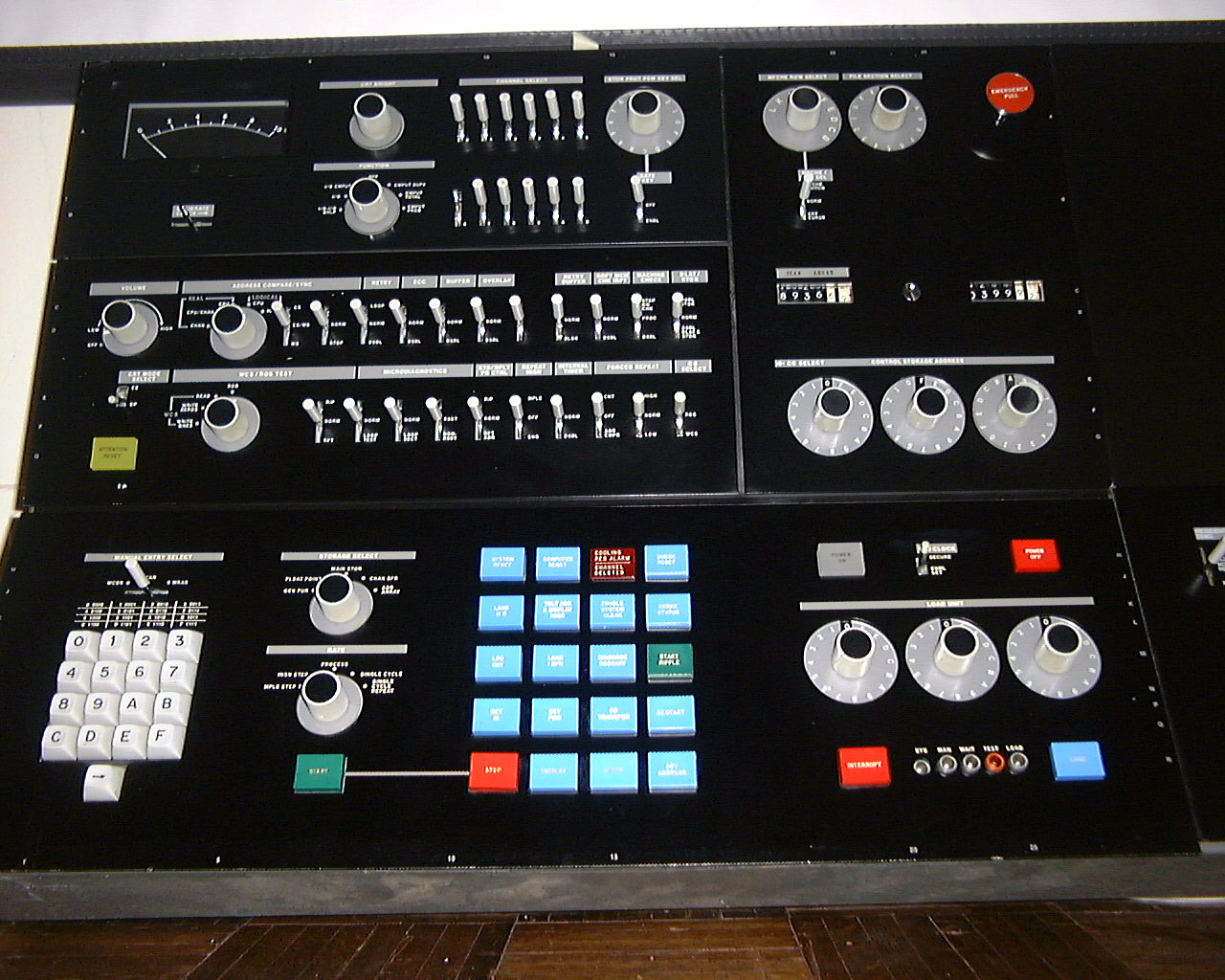
>Some IBM 370's had a big galvanometer on the front,
>EG the '168 had one even with the massive CRT
>up there on the panel.
>(photo courtesy the corestore)
> http://www.corestore.org/370168-1.jpg
>
>AIX / RS6000 had a nice set of onscreen meters.
>
>Old fantasy: working Apollo CM control panel with all
> the lights, switches and barberpoles.
>
>John A.
Check out www.spaceref.com/exploration/apollo/acgreplica/
to build your own block 1 AGC.
Allison
Hey everyone!
I need some help. I have an RL02 disk drive that sat in a warehouse for
awhile, and somehow it got spiders (and their webs) in it, and the previous
owner contaminated the drive by shipping it exposed in foam and the foam got
all over the inside of the drive. What's the best method to disassemble and
clean an RL02 disk drive in this situation? There's none in the drive
platter area, but it's all down in the cavity below it.
Thanks
Julian
I live near Newark, Delaware and I am interested in acquiring a Computer
Data Systems "Versatile 2" computer. This company was based in Newark,
Delaware USA in 1977. I know practically nothing about this company,
and the Delaware Historical Society has little more than their old
address. As one of the few collectors in the area, I hope to "bring
one of these systems home" for a proper preservation.
The Versatile 2 was a 1977 Z80-based S-100 system with integrated
monitor and keyboard. See:
http://www.old-computers.com/museum/computer.asp?st=1&c=345
I would also be interested in software, CDS disk drive, manuals,
documentation, ads, and whatever.
Please contact me off list if you can help. I am willing to pay $$.
Bill D
-- E N D --
> -----Original Message-----
> From: cctalk-bounces at classiccmp.org
> [mailto:cctalk-bounces at classiccmp.org] On Behalf Of Ethan Dicks
> Sent: woensdag 19 oktober 2005 5:25
> To: General Discussion: On-Topic and Off-Topic Posts
> Subject: Fischer Technik and similar logic-enhanced toys (was
> Re: OT:Language for the ages)
>
> On 10/19/05, Tony Duell <ard at p850ug1.demon.co.uk> wrote:
> > > Real nerds use Fischer-Technik.
>
> I saw that stuff in the early 80s and couldn't come close to
> affording it.
>
> > Fischer Technik has gone down spectacularly since I was a
> kid. In the
> > old days there were fairly simple elecrronic modules (alas so
> > expensive that I couldn't afford enough of them) -- things like a
> > double pole changeover relay, analogue voltage comparator,
> AND gate,
> > OR gate, flip-flop, monotstable, etc.
>
> I remember that stuff - in particular, I remember enough
> logic for an elevator controller and a traffic light.
>
> I'd _love_ a way to home-brew some sort of snap-together logic toy.
> For that matter, I'd love a way to make something like a DEC
> Logic Lab from stuff around the house (i.e. - a 2 sq ft board
> covered with logic and plug points)... One could use banana
> jacks, etc., for the interconnects, but at retail pricing,
> that would start to add up to real money real fast.
>
> -ethan
I read a few months ago an interesting article about a virtual
building blocks piece of freeware software to be downloaded from
http://www.muvium.com/ It is the "link" Virtual Breadboard, but
it is already also for months announced with "Coming Soon.."
I regularly keep watching this site ...
- Henk, PA8PDP.
This message and attachment(s) are intended solely for the use of the addressee and may contain information that is privileged, confidential or otherwise exempt from disclosure under applicable law.
If you are not the intended recipient or agent thereof responsible for delivering this message to the intended recipient, you are hereby notified that any dissemination, distribution, or copying of this communication is strictly prohibited.
If you have received this communication in error, please notify the sender immediately by telephone and with a "reply" message.
Thank you for your cooperation.
On 10/19/05, Tony Duell <ard at p850ug1.demon.co.uk> wrote:
> > Real nerds use Fischer-Technik.
I saw that stuff in the early 80s and couldn't come close to affording it.
> Fischer Technik has gone down spectacularly since I was a kid. In the old
> days there were fairly simple elecrronic modules (alas so expensive that
> I couldn't afford enough of them) -- things like a double pole changeover
> relay, analogue voltage comparator, AND gate, OR gate, flip-flop,
> monotstable, etc.
I remember that stuff - in particular, I remember enough logic for an
elevator controller and a traffic light.
I'd _love_ a way to home-brew some sort of snap-together logic toy.
For that matter, I'd love a way to make something like a DEC Logic Lab
>from stuff around the house (i.e. - a 2 sq ft board covered with logic
and plug points)... One could use banana jacks, etc., for the
interconnects, but at retail pricing, that would start to add up to
real money real fast.
-ethan
Somewhere my last posting didn't find its way to the list, although
there were some downloads of the files below.
Retry (with few typo corrections)::
Hi,
for quite some time I have some magazines of COMPUTE ("Club Of
Microprocessor Programmers, Users and Technical Experts"), a newsletter
sponsored by National Semiconductor, lying around which I consider
worthwhile to be conserved for the past. The date I am talking about is
around 1975..1977.
Some questions:
1. I have only some issues, namely V2N7...V2N12, V3N4...V3N7. Does
anyone have other issues (and is willing to scan or copy those)? I'd be
very interested in this epoch.
2. Scanning: You find a sample issue at
http://www.ais.fraunhofer.de/~veit/v2n7.pdf (2MB). This was scanned B&W
400dpi, stored as TIF and converted with Acrobat. My problem is that
even with this some listing pages are barely readable, see page 5 for
example. This is probably because of lack of contrast; the magazine is
printed on light brown paper with dark brown text; other issues use blue
or green text color which is probably even less readable in a scan. If
one scans in color with 600dpi (as in sample
http://www.ais.fraunhofer.de/~veit/3x.pdf, 2MB) this will result in much
larger files - the raw TIF is 95MB on my disk, which is not a diskspace
issue for me, but for downloaders; expect a single issue to be 40MB and
more in size.
Do the "professional scanners" here, like Al, have a recommendation for
resolving this?
Regards
Holger
I'm working on a public service project being funded and hosted by a semi-
major internet-based institution (sorry, gotta keep low-key about it in
public until the big announcement).
The resulting work will be a public domain utility that will be useful for
everyone who works with computers, and somewhat directly relates to what
we do here as computer and software collectors.
If you have a couple hours to spare each week to do minimal research and
data entry over the web, please contact me directly and I will fill you in
with the details.
Thanks!
--
Sellam Ismail Vintage Computer Festival
------------------------------------------------------------------------------
International Man of Intrigue and Danger http://www.vintage.org
[ Old computing resources for business || Buy/Sell/Trade Vintage Computers ]
[ and academia at www.VintageTech.com || at http://marketplace.vintage.org ]
Hi Everyone,
I've been trying to give Jay a link to my PDP11 board, but haven't heard
back from him. When I spoke to him in person, he asked I resend him the
link, and I have several times and haven't heard back so I figured my mail
was getting filtered. Anyway, sorry to spam the list with this, but I
couldn't think of any other way to get ahold of him.
Jay, that address is http://pdpusers.dyndns.org - title is "PDP-11 User
Community" (as I'll be working to get more than just a message board up on
it soon)
Sorry everyone. Thanks Jay!
Julian
I have an old Tektronix Colorquick 4696 inkjet printer with the good ol ink wells and I want to restore it. It works with an old Innovion / CASI futura II computer photography system from the 80's.
Anyway I need to get the printer to do a clean cycle and I KNOW it had one, I just don't know what dipp switch settings were needed to make this happen. Also a list of the dipp switch settings or a manual would be very helpfull. (right now the unit prints yellow, blue and a strange dark green for black)
On the same topic the unit uses a green maintenance fluid, which i'm going to run out of eventually and I am wondering if anyone knows of a good substitute OR better yet what this stuff really is?
I would like to get my old futura up and running but it only works with a Balloonjet printer from around 1987 (no idea what that is) or a Tektronix 4696/4695. pictures of said system here @ colortron.tk Also general information on Innovion, CASI tech and their systems is always appreciated.
Thank You For Any Information
Ryan
At 18:08 -0500 10/14/05, cctalk-request at classiccmp.org wrote:
> >Suppose you wanted to write an application for a manufacturing process that
> >will, in all probability, run for the next 30 years....
Also depends on how inviolate the code must be, and how verifiable
the system. If you need to re-create the system, FORTH can be
implemented with a lot fewer gates of hardware and a lot fewer lines
of code than JAVA - and would therefore be a lot easier to verify, if
you need to design/build new hardware to run your legacy code on in
25 years.
--
- Mark
210-522-6025, temporary cell 240-375-2995
>
>Subject: Re: Public Service Announcement: AVOID "bobsbid1"
> From: woodelf <bfranchuk at jetnet.ab.ca>
> Date: Wed, 19 Oct 2005 09:58:15 -0600
> To: General Discussion: On-Topic and Off-Topic Posts <cctalk at classiccmp.org>
>
>Kevin Handy wrote:
>
>> Steven N. Hirsch wrote:
>>
>>> Gotta love it when the golden-eared folks apply RF transmission-line
>>> theory to speaker cabling. My scepticism towards audiophile
>>> snake-oil comes via heredity (my late father spent 40+ years in the
>>> industry).
>>>
>>>
>> The snake-oil industry?
>
>So how many people oil their snakes? It does seem hard to get a good
>Hi Fi system nowdays with all the snake oil parts as you have just so cheap
>stuff on the low end, and gimics on the high end. With audio nobody gives
>any useful specs now days -- THD is done into a dummy load never a
>real speaker. What about IM distortion too? PS. I listen to regular music;
>classical I find too heavy.
Every time I need an amp for audio, I build one. I have no excuse, I did
audio consoles and the like. None of the chips have decent specs and
reasonable solid state designs with transistor or power MOSFETs are
not hard to cook up.
What amuses me are the systems that have a wallwart (not switch mode either!)
as a PS and claim more than 10-15W of power out. I include those that have
a PS inside that is barely a wallwart. A typical wallwart can't provide
that and a real amp that can do that needs a better source of power.
Computer speakers are amoung the worst with the claims, most are outright
fraud.
Allison
Paul Koning <pkoning at equallogic.com> wrote:
> C is the obvious choice. In either case, you have to be careful that
> you don't wreck the portability by using non-portable I/O.
Er, how big is an int? a pointer?
**vp
>
>Subject: Re: OT: Language for the ages
> From: woodelf <bfranchuk at jetnet.ab.ca>
> Date: Wed, 19 Oct 2005 10:48:32 -0600
> To: General Discussion: On-Topic and Off-Topic Posts <cctalk at classiccmp.org>
>
>Gordon JC Pearce wrote:
>
>>>
>>> You're absolutely right.
>>> I like those sizes, because they're a good fit with my hardware.
>>
>>
>> ... therefore using an 18-bit int would be silly. If you were using a
>> machine with a 9-bit byte length (not parity, actually 9 bits) then it
>> wouldn't seem such a bad idea.
>
>Strange -- my hardware is just like that ( When I get it finshed ) .
>The PDP-10 has done that already.
>Oddly this homebrew I am working can't do real C, since now C is almost
>allways 32 bit code and
>I've got only a whoopping 64kb of ram. :( I think a 20 bit int is
>also a nice size too and 10 bit bytes.
>
>>
>> Gordon.
CDC6000 or was it the Interdata 8/32 used a nine bit char.
Funny thing about all this. I see focus on the char, int and longs and
pointers with little regard to is the machine Von or Harvard and other
considerations such as base machine registers, addressing modes and
conditional branch capabilities. All that is needed is enough bits
to do the task(s) desired. There is a point where standard C doesnt
fit well enough to justify it. That doesnt negate a subset however.
Allison
Greetings folks & folkettes;
It is with some sadness that I must offer up my System/34 to fellow
collectors. I have never gotten a 220v hookup for it, and I need the space
it lives in (my garage) for this coming winter.
The unit is complete, with four disks. I have some great number of floppy
disks for the machine (multi-hundred, although a bunch that came with it
are formatted TRS80), 24 disk jukebox cartridges, plus a large selection
of documentation and schematics.
OS disks are included.
For my own pickup information and details pictures of the machine and what
comes with it, you can head here:
http://www.kiwigeek.com/hjp/comps/IBM_s34/
I expect nothing for it, I am hoping someone will come and pick it up,
which I'll certainly be more than willing to help with.
We live out of Hampton, Iowa (North-Central).
Thanks;
JP
Hi Rich,
No, I've never found a source for those roms. What
few leads I did get didn't pay off. I think it's been
close to 2 years since I last posted anything about
them so maybe it's time to bring it up again.
Sooo... If anyone has a Cromemco SCC board with ROMs,
please check them to see if they are the MCB-216 roms.
There were two 2716 roms in sockets 0 and 1 containing
a monitor program and 3k control basic. We need an
image of these roms or a text hex/decimal/octal
listing would suffice (anything machine or human
readable as long as it's accurate and complete).
Pete T. and Randy M. on the list were also looking for
these.
It'd be nice to find these before I pass on and my
wife and kids get to dispose of my stuff.
Keep on keeping on,
Joe
>Hi Joe,
>I was wondering if you ever found the MCB-216 roms,
or source code for
the
>Cromemco SCC board. I am also looking for them.
>Let me know if you can help.
>Thanks!
>Rich
__________________________________
Yahoo! Music Unlimited
Access over 1 million songs. Try it free.
http://music.yahoo.com/unlimited/
We've just been offered one of these - I'm assuming (awaiting further
details) that it's a rebadged Apple II Plus, as in:
http://oldcomputers.net/bellandhowell.html
... but that doesn't mention the "Digital Video Presentation" side of
it, or even any video extras over and above what the II Plus has.
Anyone know any more details? Did Bell and Howell ever do any other
computer-based systems?
I will get some more info from the owner (and they have the full doc set
apparently), but I'm being impatient :-)
cheers
Jules
Hi Frank,
Thanks for the reply, Joe R responded to me yesterday and told me about
it being a hard drive, I sent him back some pictures, which I have
attached, in hopes of identifying what I have. If you know what it is, I
would appreciate the help, let me know if more picture or anything else
would help.
Thanks Again
Phil
-----Original Message-----
From: Frank McConnell [mailto:fmc at reanimators.org]
Sent: Tuesday, October 18, 2005 10:21 PM
To: cctalk at classiccmp.org; Matthews, Phil
Subject: Re: HP 9133
Phil Matthews wrote:
> I have been looking at your cctalk bulletin board and it appears that
> Frank McConnell is someone who knows a lot about old HP computers. I
> have been tasked to replace the HP 9133 computer on some of our test
> equipment with new PC's. I was hoping to contact somebody who might
> know if this is possible and how to do it. So I was wondering if you
> knew how I could contact Frank McConnell or somebody who might know.
Appearances can be misleading. I mostly wonder why it is that I
remember how to take apart a 262X terminal better than I remember what I
was working on last month.
And, my work with this stuff was in a data processing and office
automation environment, so what I remember is mostly terminals and
HP150s and some early Vectras and of course classic HP3000s. There are
other folks who read cctalk who have more clues than I do about the
test-equipment side of HP, so posting to cctalk may get you more help
than I can give you.
One thing I am sure of, your first step is to take another look at your
system. The 9133 is a disc drive; actually it is two of them, hard and
flexible. It does have a microcontroller, but its firmware is about
being disc drives, not about computing. Something else in there is the
computer, and you need to look again and find out what that is.
-Frank McConnell
I need to ship about 200 pounds of computers, documentation and spares from
South Africa to Boston.
Any suggestions on shipping this economically (and safely). It seems FedEx
is quite expensive does not
make economic sense for me..are there alternate carriers or methods (e.g.
via Ship) that make sense to
Look at?
How do I deal with customs?
Thanks,
Chandra
Hi Chandra and all
>I need to ship about 200 pounds of computers, documentation and spares from
>South Africa to Boston.
What? I didn't know we had computers over here that would be
worth shipping anywhere...
>
>
>How do I deal with customs?
Your side? Should be easier if you could prove that they
were originally made on your side of the pond?
>Probably the cheapest way to deal with this is to contact the different
>Airlines and set up an airport to airport delivery. You might have to settle
>for South Africa to New York. Not sure there are direct flights from South
>Aftrica to Boston.
SAA flies to Atlanta.
If you're not in a hurry, stick it on a ship. Takes most of
a year, or maybe it just feels like it, but it mostly gets
there.
W
> -----Original Message-----
> From: cctalk-bounces at classiccmp.org
> [mailto:cctalk-bounces at classiccmp.org] On Behalf Of Ethan Dicks
> Sent: woensdag 19 oktober 2005 5:25
> To: General Discussion: On-Topic and Off-Topic Posts
> Subject: Fischer Technik and similar logic-enhanced toys (was
> Re: OT:Language for the ages)
>
> On 10/19/05, Tony Duell <ard at p850ug1.demon.co.uk> wrote:
> > > Real nerds use Fischer-Technik.
>
> I saw that stuff in the early 80s and couldn't come close to
> affording it.
>
> > Fischer Technik has gone down spectacularly since I was a
> kid. In the
> > old days there were fairly simple elecrronic modules (alas so
> > expensive that I couldn't afford enough of them) -- things like a
> > double pole changeover relay, analogue voltage comparator,
> AND gate,
> > OR gate, flip-flop, monotstable, etc.
>
> I remember that stuff - in particular, I remember enough
> logic for an elevator controller and a traffic light.
>
> I'd _love_ a way to home-brew some sort of snap-together logic toy.
> For that matter, I'd love a way to make something like a DEC
> Logic Lab from stuff around the house (i.e. - a 2 sq ft board
> covered with logic and plug points)... One could use banana
> jacks, etc., for the interconnects, but at retail pricing,
> that would start to add up to real money real fast.
>
> -ethan
Oops, I feel stupid. I was watching this site for months to find out
*now* that at the lower right side there are links to older versions.
See "Virtual Breadboard Legacy Versions Home " with links to 1.2 and
1.0. When you click the "1.2" link you get a page which also has
tutorials. Going to check that out ...
- Henk, PA8PDP.
This message and attachment(s) are intended solely for the use of the addressee and may contain information that is privileged, confidential or otherwise exempt from disclosure under applicable law.
If you are not the intended recipient or agent thereof responsible for delivering this message to the intended recipient, you are hereby notified that any dissemination, distribution, or copying of this communication is strictly prohibited.
If you have received this communication in error, please notify the sender immediately by telephone and with a "reply" message.
Thank you for your cooperation.
Back in June of last year, I posted the following message: "It's a DEClaser
3500 with FIVE extra cartridges. Location is central New Jersey. The
printer works well."
Now it's for sale again but some details changed. Now there are four extra
cartridges, not five. Also, it no longer "works well". I gave the printer
to my parents, who report that it only works when it's in a good mood, and
that many times it leaves a strange streak on the page.
But, hey, it's DEC. That ought to interest someone. :)
This sucker is HEAVY so I have no idea what it would cost to pack and ship.
Anyway, make me an offer. I wouldn't mind trading for a dot-matrix
ImageWriter printer/ribbons for my Apple //c. (Yes, Sellam, I know you have
87 of them, but I feel better bartering in a fair manner!) ... Or, as you
all know, I'm always looking for interesting vintage handhelds.
- Evan
-----------------------------------------
Evan Koblentz's personal homepage: http://www.snarc.net
Computer Collector Newsletter: http://news.computercollector.com
Mid-Atlantic Retro Computing Hobbyists & Museum:
http://groups.yahoo.com/group/midatlanticretro/
> Here's an interesting problem.
>
> Suppose you wanted to write an application for a
> manufacturing process that will, in all probability, run for
> the next 30 years. No direct control of the process itself
> is entailed (i.e., you don't need the program to operation
> valves or run motors), but you do need this program to
> compute manufacturing parameters for each customer. I/O
> requirements are very modest, mostly simple keyboard and display.
>
> What would you write it in? Clearly, you'd want to be
> independent of a particular software vendor, so the likes of
> Visual BASIC isn't an option.
> You'd also want to write in a language that isn't nearing
> obsolescence, nor one that's still evolving. "Niche"
> languages would be out of the question, as longevity could be
> a problem.
>
> So what would it be? My vote is for FORTRAN.
I've been following this thread for a few days now, and I'd like to contribute my $0.02.
The original problem statement asserted several presumptions:
>you'd want to be
> independent of a particular software vendor..
>...
> You'd also want to write in a language that isn't nearing
> obsolescence, nor one that's still evolving. "Niche"
> languages would be out of the question, as longevity could be
> a problem.
I think a number of people were duped by these presumptions into focusing on the longevity of
the language. To me, having seen many good things come and go, I would not speculate on
the longevity of anything that we could conclude might have permanence. Many languages have
appeared to be "the answer for all time" only to fade into obscurity, not for lack of good
qualities, but because of the money behind some other language's marketing department and
the heat of passion for the new stuff in the buyer's pockets.
But in the stated problem there are larger issues that have mostly gone by without discussion.
Given the original problem statement, I would have to ask:
- If the app is not "controlling the process itself", then what is it controlling?
Given that the process varies per customer but the app does not control the process itself, then
I'm going to hypothesize that the app controls information about the process, such as variations in a
manufacturer's process "recipe". For example, the process produces a commodity such as gasoline,
and different customers each purchase their own formulation.
If the output is a custom formulation, then, after any number-crunching, the app could produce a very
simple text document.
Would such an application require the power of FORTRAN or C?
If the I/O is mostly for data entry and display, then couldn't a raw Access databse suffice? At the very
least, the data could be more easily forwarded to a newer environment than custom code.
- Will the application run on a general-purpose computer or on a specific architecture?
If general purpose, then survivabilty of the language (its development and operational environments)
would be of primary concern.
If on a specific architecture, it would make sense to write it in the machine language of that platform,
provided it was fully documented with specs and functional comments.
- Is the manufacturing process expected to persist without significant changes for the 30 years?
If so, the app could be burned into a stable media (PROM, EEPROM, or the like).
But if it would be subject to significant changes, perhaps better to maintain source and compiled
versions.
Having run a factory for 6 years, I understand the desire for a solution that can be created and
left alone. But 20 other years in business and in systems, I know that things change, and often when
least convenient and most costly to rectify.
It is a good goal to want a system that will run unaltered and survive for 30 years. But will the business
still be in business then? Or will the industry have changed, the need for the product in the marketplace
have changed, the machinery or degree of meeting customer variation have all gone away?
I think the solution to this problem does not lie in having "one right answer", but in having a
data-forwarding strategy that is flexible, responsive, updatable, and maintainable. It would be better
to change the app several times in the 30 years with reasonable costs than to bet on one solution that
could be broken a few short years later. Just depends on what's at risk and how much of a gambler you are...
So, I hope that's some food for thought...
-John M.
Montclair, NJ
Fellow classic'ers,
An idea just occurred to me, one that was inspired by a 'group buy' I did several years ago, on behalf of the ClassicCmp community, for Teledisk.
Before I can even consider implementing it, though, I need to know how many of the group's members own one or more of the following Data I/O device programmers: UniSite or UniSite XPi, 2900, 3900, or 3980 XPi (in short, any one of the 'UniFamily' programmers).
I see no need to clutter the list with responses. Please contact me off-list. If, for whatever reason, you try to reply and it bounces, try my backup address of kc7gr at qsl dot net.
Thanks much.
-=-=-=-=-=-=-=-=-=-=-=-
Bruce Lane, Owner & Head Hardware Heavy,
Blue Feather Technologies -- http://www.bluefeathertech.com
kyrrin (at) bluefeathertech do/t c=o=m
"If Salvador Dali had owned a computer, would it have been equipped with surreal ports?"
Hi,
I have been looking at your cctalk bulletin board and it appears that
Frank McConnell is someone who knows a lot about old HP computers. I
have been tasked to replace the HP 9133 computer on some of our test
equipment with new PC's. I was hoping to contact somebody who might know
if this is possible and how to do it. So I was wondering if you knew how
I could contact Frank McConnell or somebody who might know.
Sincerely
Phil Matthews
DRS Optronics Inc
Electrical Engineer
(321) 309-2124
phil_matthews at drsoptronics.com
I slapped an AHA 1640 PCMCIA card in my Linux laptop, compiled
tapetools 0.4 and 0.6 and started shoving tapes in my TSZ07. I wrote
these tapes myself a number of years ago, and have finally gotten
around to attempting to extract them. Things seemed to go fine,
except that on certain tapes, I saw a page or two of partial records
reported - i.e. - these VMS BACKUP tapes were written with a block
size of 16384, and some tapes report ~2500 records of 16384 bytes
(1600 bpi), and some report a few hundred records of 16384, then a few
at a smaller number, then more at 16384, etc. I'd think there were
some read problems, but the tape wasn't shoe-shining - it buzzed along
at full tilt.
Does anyone here have any experience with reading VMS BACKUP tapes
with tapetools? Can you share your observations? I haven't yet tried
reading the files - I know there were some VMS BACKUP extractors in C
years ago, and I've even used them, but I'll probably have to re-find
and rebuilt them. I could also fire up simh and VMS, but at the
moment, my VMS install CDs are somewhere else.
I'm really just after the data for now - it's all the stuff I worked
on at Software Results years ago - all the COMBOARD software as well
as a wad of personal files (one-off programs, stuff from newsgroups,
etc.). I still have the Fuji Eagle that was spun down a few weeks
after the backup was made, but I haven't attempted to power that up
yet to see if it still works.
Thanks for sharing any tapetools stories (and any suggestions about
'modern' VMS BACKUP extractors).
-ethan
I noticed my HP 262X terminals have a "Duracell TR133" battery in the back
to maintain settings when powered off. The battery indicates "Mercury" on
the side.
Are mercury batteries rechargable? I would have thought they'd use a nicad
or something to charge up while the unit was on.
The TR133 battery also indicates "4.2V". It seems the Duracell replacement
for this battery is Alkaline, and 4.5V. Should I use it?
Jay
Hi,
A fellow programmer / collector recently passed away,
and I'm helping his widow find homes for some of
his hardware, software, manuals, etc.
She just wrote to me:
I have found another stack of HP Journals,
not every month, from 1979-1987 and 1992.
Are they keepers?
IIRC, I've got a box of HP Journals from her already,
that I was planning on taking to the Vintage Computer
Festival (www.vintage.org).
Anyone here interested in HP Journals should email me
for discussions / offers. No, I do not have a list of
issues available at this time. I hope to be reunited
with the box (making its way from Phoenix) before VCF,
but...
thanks,
Stan
Sorry for the interruption to your normally scheduled off-topic messages.
Cameron,
I occasionally get the following error when attempting to e-mail you:
----- The following addresses had permanent fatal errors -----
<spectre at floodgap.com>
(reason: 553 5.3.5 system config error)
----- Transcript of session follows -----
451 4.4.1 reply: read error from mail.floodgap.com.
553 5.3.5 mail.flactem.com. config error: mail loops back to me (MX
problem?)
554 5.3.5 Local configuration error
It's happened twice this morning, and once about a couple weeks ago.
--
Sellam Ismail Vintage Computer Festival
------------------------------------------------------------------------------
International Man of Intrigue and Danger http://www.vintage.org
[ Old computing resources for business || Buy/Sell/Trade Vintage Computers ]
[ and academia at www.VintageTech.com || at http://marketplace.vintage.org ]
Do you still have this board? I think the part number is MLSI-DR11BO
Attached are a couple of pictures.
Steve Andow
Process Control Systems Int'l
11993 Ravenna Rd. Suite 5A Chardon, Ohio 44024 USA
Phone: (440)286-4440 Fax: (440)286-8630
sandow at proconsysint.com
> Do the "professional scanners" here, like Al, have a recommendation
for
> resolving this?
"Why should we pay you, when we get what you do for free?" - John Toole
(CHM)
It doesn't appear i'll be doing this "professionally" any time soon.
--
To answer your question, I scan low contrast color text on a high
resolution
color scanner and try to maximize contrast before doing the
thresholding to
black and white. Graphic Converter on the Mac has a number of built-in
filters
that make it very easy to interactively do this.
Once I have the values, I can batch convert the scans using the
scripting in GC.
There is probably something in the Linux or Windows world that is
equivalent,
though the tools I've tried there aren't nearly as easy to use as GC.
The covers on the Oregon State timsharing system memos on bitsavers was
a
document that I had to fiddle with to get an acceptable scan.
They are brown on dark orange paper, which came out totally black on
the IS520
B&W scanner (which uses a green scanning lamp).
All:
There was a discussion a while ago about IBM killing OS/2 and
why shouldn't they release it under some sort of GNU-like license.
Well, I think I confirmed an answer. There is an interview in
the October 12th issue of PC Magazine between Mike Miller of PC Magazine and
Bill Gates, celebrating the 20th Anniversary of Windows. The interview
question is talking about the memory management of Windows compared to OS/2
and how Lee Reiswig (former IBM GM) was crashing Windows in OS/2
demonstrations in the early-'90s.
Bill Gates continues, "It's all very ironic, because it's most
of the OS/2 code is still our code and we're still selling LAN Manager.
Whenever we'd go out and criticize OS/2, that group {within Microsoft} would
say 'we just took more friendly fire.'"
There's the answer as to why IBM cannot release OS/2. I know we
alluded to this fact in the original thread but this is the most positive
confirmation I've seen.
Rich
Lets see...
The wall calendar has May 31st as being Tuesday,
possible years 1982, 1993, 1999 & 2004
Did 'Express Mail' exist/have that logo in '82?
Brian
>> Does it come with the broad?
>>
>> Also, I like the period appropriate fake wood paneling :)
>
I> suspect the picture itself is period, meaning that broad is now, what, 50?
>
>Gil
A colleague of mine is looking for a boot disk for a Kaypro 4 '84. He
says :
"I have a Kaypro 4 (83), Kaypro 4(84), and a Kaypro 10.
The boot disks for all three are mutually incompatible.
What I still need is a boot disk for Kaypro 4(84)."
(These are 5.25 inch floppies, of course. An actual disk would be great,
but he says that if somebody wanted to send a disk image, he could work
with that, as long as he knew what program was used to create it.)
Can anyone email me images of all boot disks or direct me to appropriate
web site? I will reimburse postage/disk costs if someone wishes to send
physical disks instead of emailing images.
Braldey Slavik
>
>
>Date: Fri, 14 Oct 2005 18:18:11 +0100
>From: Bert Thomas <bert at brothom.nl>
>Subject: Re: Releasing OS/2
>
>
>Cini, Richard wrote:
>>
>> Bill Gates continues, "It's all very ironic, because it's most
>> of the OS/2 code is still our code and we're still selling LAN Manager.
>> Whenever we'd go out and criticize OS/2, that group {within Microsoft}
would
>> say 'we just took more friendly fire.'"
>>
>> There's the answer as to why IBM cannot release OS/2. I know we
>> alluded to this fact in the original thread but this is the most positive
>> confirmation I've seen.
>
>I disaggree on the argument. M$ contributed no 32-bit code to OS/2 as
>far as I can tell. IMO it is the 32-bit code that made OS/2 superior to
>Windows. BTW, OS/2 has some features that are not available on any other
>OS, such as the immense flexibility of running DOS programs. One can
>even write special device drivers that emulate a device in a virtual DOS
>machine. There are many settings available for VDMs and features like
>detecting polling loops to prevent waisting time I have never seen before.
>
>Check out "The design of OS/2"
>
>Bert
>
>
Hi Rich and Bert,
Rich, thank you for the reference to the 20-year anniv. issue of PC Mag,
but regarding Gates: Gates is so slippery that I have to take much of what
he says with multiple grains of salt. In several (perhaps many?) respects
he's a classic sociopath. He all-to-often takes credit where none is due.
He doesn't speak or write well, and if so many didn't believe that he was
some sort of "genius," there would be little reason to listen to what he
has to say. I mean, this is the guy who initially dismissed the www for
probably 2 years. What a knucklehead he can be... He may also be the
asshole who started the "Gary went flying" rumor/classic piece of
disinformation (and if it was not him, he was "in on it," and he actively
promoted it).
Regards,
Bob Greenstreet
I did find the tech manuals (from classiccmp's mirror of bitsavers).
Tony, IIRC it says the early drives *did not* have brushes and later model ones were equipped with them? Incidentally this drive started life as an RL01 but also has a DEC sticker "changed to RL02 by PCO" just to further confuse things.
Do you still recommend I not install them? I think that airflow and centrifugal force might be the only safe way to remove particles rather than "grinding" them across the disk platter surface with a brush, no matter how lightly...
I think there may also be a "Fault" if the brushes are not parked?
Ethan, thanks for the suggestion about using a 40 pin double-ended-Berg cable from inside the drive. I haven't taken the electronics cover off yet. I only have one 8/A and one RL02 so once mounted in the rack cabinet they'll stay there, connected to each other. The 40-pin cable will be, of course, trivial to make IF the pinouts are the same on both ends.
Unless someone has the correct RL8A-to-RL02 cable, and a terminator, they would like to sell me?
thanks
-Charles
Cleaning out the library; before they go into the dumpster,
anybody need/want some manuals for the Toshiba
T100 & T300?
T100 Personal Computer Owner's Manual
T100 Personal Computer Programmer's Reference manual
(CP/M & T-Basic)
T300 Personal Computer Owner's Manual (incl. Diagnostics disk)
T300 MS-DOS Reference Manual
T300 T-Basic16 Reference Manual
5 1/2 x 8 1/2, in 3 ring binders.
Reply off-list pls,
mike (Toronto)
Well, I decided to take another crack at getting my 11/34 system working
again. Currently I've still got some problems with it - firstly though, the
power supply. It blew when I hooked one of the front panel switches up to
it, though nothing seemed to be wrong as far as what I could tell from all
the diagrams.
Right now the disassembled BA11-K box is sitting in my living room taking up
space. Now, when the PSU blew, I was able to notice that the spark came
>from what LOOKED like the portion that the power cord comes from.I looked at
the traces under a magnifying glass, and couldn't see anything wrong, and I
can't smell anything. I checked all the fuses, those seem to be sound.
In any case, when hooked up to nothing, the fans don't even kick on.
Can anyone give me a test process I can go through to diagnose the problem,
or would anyone here be willing to look at the power supply for me if I
shipped it to them?
As it is, I have this dead machine doing nothing and my girlfriend keeps
pestering me about it every time she comes over because it doesn't work.
In any case, I'd appreciate any help that could be given to me!
Thanks!
Julian
Pet peeve ... what does OFHC copper have to do with was the subject
line?????????????
ISTR that OFHC copper had some benefits for certain copper plating baths
that resulted in better ductility with the plated copper. A quick google
search indicated that OFHC copper has slightly better purity than
standard copper (99.00% vs 99.95%.)