I have the keyswitch from a 2105/2108/2112 type system available, snagged it
>from the trash. This is the key switch style that has an "R" position (ie.
an electronic keyswitch, not just a mechanical one).
This is the 3 or 4 layer discs with a cord and molex-style connector that
goes to the power supply. No key, no keyhole, just the switch assembly
itself with cord and connector. I have no M machines with that style
keyswitch (mine have all been 'upgraded' to the mechanical keyswitch).
Price... 1xpostage+postage. I would expect postage to be like... 2 bucks.
Jay
Whilst waiding through the IRISes power supply, I found another exploded paper cap. (PS date 1985).
Is this likely normal, or should I look somewhere else (don't have a working scope). Would the failure of one cap put more stress on the remaining ones?
When I get the machine working, I hope to have something interesting to report, but I have no confirmation yet.
ScottQ
Hi Tony
I would guess that it is the same as a TI 806 DTL.
I don't have a data book for that but it seems like I
found one on the web someplace when I was looking at
some of the DTL's in my Nicolet computer.
Dwight
>From: ard at p850ug1.demon.co.uk
>
>The Subject: line says it all really, but perhaps I should give a little
>more explanation.
>
>I am working on an HP59405, which is the HPIB interface for the HP9830
>'calculator'. On the PCB are 2 chips which cross to something called an
>MC1806. This is not in any of my Motorola databooks.
>
>What I have determined (I think) so far :
>
>1) 14 pin DIL package, power on 14, ground on 7 as usual.
>
>2) Seems to be a quad 2-input device, pinout as the 7400 -- that is,
>inputs on 1 and 2, output on 3, etc.
>
>3) Seems to be DTL in that the output directly drives the base of an NPN
>transsistor, the emitter of which is grounded.
>
>4) The most logical (!) function would be a quad 2 input NOR gate. Maybe
>an AND gate?
>
>Does anyone have a databook that lists it?
>
>-tony
>
>
>From: "Vassilis Prevelakis" <vp at cs.drexel.edu>
>
>ard at p850ug1.demon.co.uk (Tony Duell) wrote:...
>> Hmmm. I thought it was where the taps stuch to itself, or to the drive
>> belt, when the catridge was stored. In which case your idea might not
>> help much.
>
>Aha! There goes my original hypothesis. Well, that is relatively easy to
>check. I took apart two old tapes and found the following:
>
>Assuming that the tapes were rewound before storage, there are two
>stretches of weakened magnetic coating on both tapes I looked at; the first
>was short while the second longer. These correspond to the length of tape
>in contact with the drive belt
>
Hi
It sounds like the belts should still have any data that was
on the tape for those stretches. Reading may be a little difficult
but the information is still in the magnetic media.
Dwight
Hey, I was just wondering if any of my fellow DECies on this list live
in the Chicago area, I know there were quite a few DEC shops around here
back in the day.
Hey, the MAC address doesn't tell me anything, but the ethernet address
I'm talking about is printed on the back of the equipment and is like;
08-00-2B-BF-94-C4
The following items we want to replace have such an address;
DEC server VXT2000+, model VX20A-EA
DEC server 700 COMM 8 port, model DSRVW-ZA
DEC server 250, model DSRVP-A
And of course our DEC3000 (rackmounted model: PE43B-XA, series BA47R)
itsself has an ethernet address.
As stated before; we are running on VMS version 6.1 and our system is 11
years old, but still running smooth. We have now bought 'new' 2nd hand
items for replacements in case one of all items run down so we can
replace it immediatly, but we are now only missing the protocol to do so
for the ethernet address items.
Hope this helps for solving the installation problem.
Rgds, Rinaldo
-----Original Message-----
From: cctalk-bounces at classiccmp.org
[mailto:cctalk-bounces at classiccmp.org] On Behalf Of Witchy
Sent: maandag 24 oktober 2005 14:13
To: General Discussion: On-Topic and Off-Topic Posts
Subject: Re: installing new ethernet address equipment with VMS 6.1
On Mon, October 24, 2005 11:41 am, Rinaldo.Eversdijk at stork.com said:
>
> Does anyone know how to install, on a alpha computer (DEC3000) running
> with VMS version 6.1 software, the same equipment with a new Ethernet
> address?
Which address do you mean, the MAC address of the ethernet hardware or a
different DECnet address? The MAC address is burned into the hardware
and
only gets changed when the machine is in a cluster IIRC, and changing
the
DECnet address is different from Phase IV DECnet to DECnet/OSI.
If you can give us some more information it'll help.
Cheers,
--
adrian/witchy
Binary Dinosaurs creator/curator
www.binarydinosaurs.co.uk - the UKs biggest home computer collection?
--------------------------------------------------------------------------
DISCLAIMER:
This e-mail and any attachment(s) sent with it are intended exclusively for
the addressee(s), and may not be used by, opened by, passed on to, or made
available for use to, any person other than the addressee(s). Stork rules
out any and all liabilities resulting from any electronic transmission.
"Joe R." <rigdonj at cfl.rr.com> wrote:
> FWIW I tested about a dozen tapes a few years ago and about 4 failed
> on the first pass, about that many failed in the next few days and
> only one lasted a week.
The tapes stick unto themselves, so it is a good idea to unwind them slowly
rather than perform a retention (CTAPE) which is a violent and abusive
treatment for a tape that is ready to fall apart.
Whether you (think you) can afford two data extraction passes (vs
one pass) on a given tape *will* affect the strategy used. In the
one-pass case you have to salvage all you can from both tracks, while
in the second case you can rewind the tape (at the slow reading
speed, of course) and have a go at the second track. The HP-85 tapes
(and their 98xx cousins) are NOT serpentine: to read track 2 you
rewind to BOT and start reading using the second head.
Unfortunately the read/write IC (1820-2418) on the HP-85 can only deal with
one head at a time (only one DIO pin), so to employ the one-pass strategy,
you either have to wire another 1820-2418 strapped to read track two, or you
have do the analog (audio) recording I suggested initially.
> They DO use the same tape so they must be compatible. I don't know about
> the track spacing but I would think they would be the same.
Bad news. I checked the specs (TechData brochures from hpmuseum.net)
and came up with this table for read/write speeds
HP 9825 22ips
HP 9835 22ips
HP 9845 22ips (didn't find any data, but I assume its 22 ips)
HP 85 11ips
HP 9815 10ips
So there goes any hope of cassette data interchange between the Series80
and the rest of the HP line. :-(
Apparently the HP-85 was a cheapo solution vs the 98[234]5 line. The speed
was slower and while this does not reflect on the total capacity of the
drive (around 240Kb), its access times are worse. This was a surprise to
me as I would have thought that HP would want to have some data exchange
capability between the newer low-end HP-85 and its high-end models (after
all they were expected to co-exist in the same environments).
> It should be
> easy enough to check with some MagnaSee. I THINK that's the name of the
> liquid that you put on mag tapes/cards to see the magnetic tracks. I have a
> can of it around here somewhere but no idea where it's at at the moment.
I have been trying to get this thing for ages, and I couldn't. In the end
I found this
www.sprague-magnetics.com/library/sprgmag.pdf
which works the same way. Initially I thought I could simply spray the stuff
on the tape and optically read the bits, but its too messy.
> Actually that sounds like a GOOD idea. Ratty looking HP 85s are readily
> available. I'd take one of those and take out the tape drive ribbon cable
> and replace it with real wires then add some test points to it and maybe
> cut some sections out of the case to allow access to it's inards and make a
> test platform out of it.
My advice is to go for 9915As I have seen them go for next to nothing on eBay,
and even then remain unsold. Apparently people do not realize that these are
Series 80, or they are discouraged by the lack of screen and (most importantly)
keyboard!
I am also afraid that by creating the series80.org site, I caused an increase
in the prices of Series80 machines, but with the hpmuseum.net slowly making all
this info available anyway, I do not feel so guilty any more :-)
**vp
PS I found another metric screw up:
In the 9835TechData-5953-0982-12pages-Oct78.pdf file in hpmuseum.net
the length of the tape is given as 426.7 METERS, followed by the
more reasonable 140ft (the HP-85B spec sheet gives the length of tape
as 43m or 140ft).
BTW2 On the HP-85 the rewind time (end-to-end) is 29 sec. When I was checking
an early capstan repair and did a CTAPE (which does a fast forward to EOT
and then a fast rewind to BOT), it felt like that thing was taking forever
(probably it took longer because I was watching over it :-)
How about this for a new book?
"Digital Retro :
The Evolution and Design of the Personal Computer"
by Gordon Laing
Amazon.com informs me that it was published just three weeks ago.
Wonder if anyone here has seen it yet?
A reviewer says its set up as Amstrad to Zenith, with photos,
might be kind of fluffy.
John A.
Anyone ever hear of / use wildcat 4? I just found an old copy my dad pirated
+ a sysop manual he ripped off of someone in a box of books he had...
Anything anyone can tell me about it? :)
Heh, oldskool BBS piracy in my own hands :)
Sorry, I lost the details, but Lou Helfer in Summit, New Jersey, has some
Commodore 128 systems to give away. Several I think. Contact Lou for
details.
Reply-to: lhelfer at comcast.net
--
Sellam Ismail Vintage Computer Festival
------------------------------------------------------------------------------
International Man of Intrigue and Danger http://www.vintage.org
[ Old computing resources for business || Buy/Sell/Trade Vintage Computers ]
[ and academia at www.VintageTech.com || at http://marketplace.vintage.org ]
Vintage Computer Festival 8.0
Saturday & Sunday, November 5-6
Computer History Museum
Mountain View, California
http://www.vintage.org/2005/main/
This is your complete VCF 8.0 event guide! Vintage Computer Festival
8.0 happens this coming Saturday and Sunday, November 5th and 6th, at
the Computer History Museum in Mountain View, California.
The doors open at 9:30am each day. Speaker sessions begin at 10:00am
and run until 2:00pm. The exhibit and marketplace open at 2:00pm and
run until 6:00pm.
Admission is $12 per person per day for full event access, including
the speakers, exhibits and marketplace, or $7 per person per day for
exhibit and marketplace only (exhibit and marketplace open at 2:00pm
each day). Parking is free, and kids 17 and under are admitted free
of charge.
Homebrew Computer Club Retrospective
The VCF in conjunction with the DigiBarn Computer Museum is proud to
present a 30th anniversary celebration of the founding of the Homebrew
Computer Club, the legendary Silicon Valley institution that helped to
launch the era of the personal computer. Bruce Damer of the DigiBarn
Computer Museum will moderate this panel of former Homebrew members,
including Steve Wozniak, Lee Felsenstein, Allen Baum, Len Shustek, Bob
Lash and Michael Holley.
Join the panel as they recount their experiences and gab with the
group as we feast on some yummy cake, courtesy of the DigiBarn:
http://www.digibarn.org/
VCF 8.0 Speaker Schedule
The speaker schedule for VCF 8.0 is as follows:
Saturday, November 5
Time Session Title Speaker(s)
------- -------------------------------------- --------------------
10:00am Film Screening: The Future of Pinball Greg Maletic
11:00am IOCCC Award Presentation Ceremony Landon Curt Noll
12:00pm VCF Shenanigans Sellam Ismail
1:00pm Homebrew Computer Club Retrospective Steve Wozinak
Lee Felsenstein
Join us in a celebration of the 30th Len Shustek
anniversary of the founding of the Michael Holley
Homebrew Computer Club. Moderated by Bob Lash
Bruce Damer of the DigiBarn. Allen Baum
Sunday, November 6
Time Session Title Speaker(s)
------- -------------------------------------- --------------------
10:00am A History of the Smart Card Jerry Svigals
11:00am Yack 'N Hack: Computers Talk Back Deborah Norling
12:00pm A Personal Re-telling of Personal Dave Freeman
Computer Retailing
12:30pm Nerd Trivia Challenge! Evan Koblentz and
three Uber Nerds
Are you up to the Challenge? Hosted vying for the prize!
by Evan Koblentz, editor of the
Computer Collector Newsletter
1:00pm In The Beginning: A BBS History Christian Wirth
Discussion Joe Russack
Ernie Longmire
A panel discussion to follow-up the
screening of BBS Documentary on day
one of the VCF. Moderated by director
Jason Scott.
For complete details on this year's speaker series including session
abstracts and speaker biographies, visit:
http://www.vintage.org/2005/main/speaker.php
Nerd Trivia Challenge
The Nerd Trivia Challenge is a trivia contest to test the knowledge of
the most serious computer history buffs. Contestants are chosen from
VCF attendees who qualify for play by taking a preliminary quiz upon
arrival at the VCF on Saturday, November 5. Those applicants scoring
highest on the preliminary quiz will be selected to compete in the
Nerd Trivia Challenge on Sunday, November 6, at 12:30pm.
The Nerd Trivia Challenge is being hosted by Evan Koblentz, editor of
the Computer Collector Newsletter:
http://news.computercollector.com
To participate in the Nerd Trivia Challenge, ask to take the NTC
preliminary quiz when you arrive at the VCF registration desk.
Film Screenings
The VCF is proud to present the first ever public screening of a new
documentary film titled "The Future of Pinball":
http://www.thefutureofpinball.com
The Future of Pinball is a new documentary on the recent history of
the pinball industry. The showing is a beta version of the film and
VCF attendees will have a chance to help direct the final cut based on
the feedback they provide.
Be sure to catch director Greg Maletic's talk on Saturday, November 5,
at 10:00am.
The VCF will also be reprising a screening of BBS Documentary:
http://www.bbsdocumentary.com
The screening will take place on Saturday, November 5, and the film
will be shown in its entirety to all VCF attendees. On Sunday,
November 6, join director Jason Scott and three of the subjects from
the film at the BBS history panel at 1:00pm.
Tours and Excursions
Guided tours of the Computer History Museum Visible Storage collection
will be conducted on Saturday, November 5, with Visible Storage open
for self-guided tours on Sunday, November 6.
For those interested in touring the DigiBarn Computer Museum, curator
Bruce Damer will lead an excursion into the Santa Cruz mountains that
will disembark from the VCF at 3:00pm.
Complete details and tour times are available on the VCF 8.0 website:
http://www.vintage.org/2005/main/tours.php
Bring On The Exhibits!
Once again the VCF has attracted some rather fascinating exhibits.
Check out what we've got in store for VCF 8.0:
http://www.vintage.org/2005/main/exhibit.php
We look forward to having you at the Vintage Computer Festival. I'll
see you there!
Best regards,
Sellam Ismail
Producer
Vintage Computer Festival
--
Sellam Ismail Vintage Computer Festival
------------------------------------------------------------------------------
International Man of Intrigue and Danger http://www.vintage.org
[ Old computing resources for business || Buy/Sell/Trade Vintage Computers ]
[ and academia at www.VintageTech.com || at http://marketplace.vintage.org ]
> One of my machines has a "Turbo" button that changes from "HI" to "LO".
The last time I jumper-programmed one of those little boards
I made the display read "SLO" and "dEd"...
W
Toresbe,
the documents I found at my place are the following:
- BT3200 Series 324x/326x/328x MagneticTape Controller: Logic Diagrams (schematics)
- BT3200 Series 324x/326x/328x MagneticTape Controller: Theory of Operation Manual
- BT3200 Series 324x/326x/328x MagneticTape Subsystem: Installation Manual √
- BT3200 Series 324x/326x/328x MagneticTape Subsystem: Maintenance Manual √
- BT3200 Series 324x/326x/328x MagneticTape Unit: Theory of Operation Manual
They are Unisys labeled, but actually, they are Fujitsu 2436 drives.
Installation and Maintenance Manuals afre already scanned in. They are somewhere on my DVDs, give me some time
to look up where they are and I can send them to you.
Regards,
Pierre
>
> Hey, I've come across a Memorex 3266 half-inch tape drive (well,
> actually several, but only one seems near to operable condition).
>
> picture: http://toresbe.at.ifi.uio.no/3266.jpeg
>
> Anyone recognize it and know what densities and interface(s) it used?
> Guesses are also appreciated ;) It's an autoloader, right?
>
> I've been googling, and also bitsavers has nothing on it. Grateful for
> any hints.
>
> -toresbe
>
______________________________________________________________
Verschicken Sie romantische, coole und witzige Bilder per SMS!
Jetzt bei WEB.DE FreeMail: http://f.web.de/?mc=021193
>From The 1969 Motorola data book:
THe MC1806 is a quad 2 input DTL AND gate.
Bob
Message: 21
Date: Sun, 30 Oct 2005 22:41:27 +0000 (GMT)
From: ard at p850ug1.demon.co.uk (Tony Duell)
Subject: Waht is an MC1806 ?
To: cctalk at classiccmp.org
Message-ID: <m1EWLrm-000Iy2C at p850ug1>
Content-Type: text/plain
The Subject: line says it all really, but perhaps I should give a little
more explanation.
I am working on an HP59405, which is the HPIB interface for the HP9830
'calculator'. On the PCB are 2 chips which cross to something called an
MC1806. This is not in any of my Motorola databooks.
What I have determined (I think) so far :
1) 14 pin DIL package, power on 14, ground on 7 as usual.
2) Seems to be a quad 2-input device, pinout as the 7400 -- that is,
inputs on 1 and 2, output on 3, etc.
3) Seems to be DTL in that the output directly drives the base of an NPN
transsistor, the emitter of which is grounded.
4) The most logical (!) function would be a quad 2 input NOR gate. Maybe
an AND gate?
Does anyone have a databook that lists it?
-tony
The Subject: line says it all really, but perhaps I should give a little
more explanation.
I am working on an HP59405, which is the HPIB interface for the HP9830
'calculator'. On the PCB are 2 chips which cross to something called an
MC1806. This is not in any of my Motorola databooks.
What I have determined (I think) so far :
1) 14 pin DIL package, power on 14, ground on 7 as usual.
2) Seems to be a quad 2-input device, pinout as the 7400 -- that is,
inputs on 1 and 2, output on 3, etc.
3) Seems to be DTL in that the output directly drives the base of an NPN
transsistor, the emitter of which is grounded.
4) The most logical (!) function would be a quad 2 input NOR gate. Maybe
an AND gate?
Does anyone have a databook that lists it?
-tony
Thanks Frank - that was close - I went to Amazon and "The Maverick and
His Machine: Thomas Watson, Sr. and the Making of IBM" appeared as a
book you buy together as package with the one you suggested.
Thanks for the tip!!!!!!!!!!!!!!
http://www.amazon.com/gp/product/0471414638/ref=bxgy_cc_img_b/102-902131
0-4684938?%5Fencoding=UTF8
++++++++++
Kevin Parker
Web Services Consultant
WorkCover Corporation
p: 08 8233 2548
m: 0418 806 166
e: kparker at workcover.com
w: www.workcover.com
++++++++++
-----Original Message-----
From: cctech-bounces at classiccmp.org
[mailto:cctech-bounces at classiccmp.org] On Behalf Of Frank McConnell
Sent: Monday, 24 October 2005 9:39 AM
To: cctalk at classiccmp.org
Subject: Re: Book worms
Kevin Parker wrote:
> I am trying to identify a book that I want to get.
>
> My vague recollection is that it was about IBM or IBM Blue and may
> have been about the history of IBM or one of its owners/directors.
>
> I vaguely recall the front cover had a man standing in it.
You may be remembering _Father, Son & Co.: My Life at IBM and Beyond_ by
Thomas J. Watson Jr. and Peter Petre. Searching eBay for "Father Son
Co." will get you some pictures.
-Frank McConnell
************************************************************************
This e-mail is intended for the use of the addressee only. It may
contain information that is protected by legislated confidentiality
and/or is legally privileged. If you are not the intended recipient you
are prohibited from disseminating, distributing or copying this e-mail.
Any opinion expressed in this e-mail may not necessarily be that of the
WorkCover Corporation of South Australia. Although precautions have
been taken, the sender cannot warrant that this e-mail or any files
transmitted with it are free of viruses or any other defect.
If you have received this e-mail in error, please notify the sender
immediately by return e-mail and destroy the original e-mail and any
copies.
************************************************************************
Hi all,
any idea which (non HP) monitors I could hook up on it ?
(It looks like FBAS, but I read somewhere, that the riming is non standard)
And, anybody can help me out with a CP/M disk for the HP 86 ?
Cheers & thanks
ard at p850ug1.demon.co.uk (Tony Duell) wrote:...
> Hmmm. I thought it was where the taps stuch to itself, or to the drive
> belt, when the catridge was stored. In which case your idea might not
> help much.
Aha! There goes my original hypothesis. Well, that is relatively easy to
check. I took apart two old tapes and found the following:
Assuming that the tapes were rewound before storage, there are two
stretches of weakened magnetic coating on both tapes I looked at; the first
was short while the second longer. These correspond to the length of tape
in contact with the drive belt
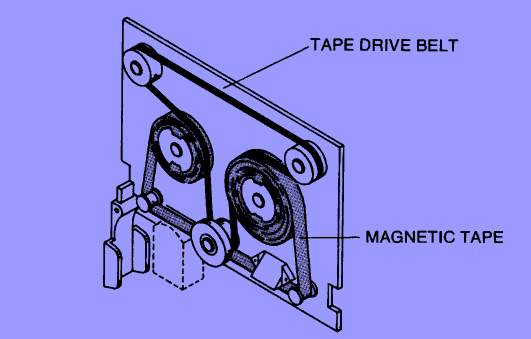
In
http://www.series80.org/Articles/tape-cartridge-lr.gif
you can see that on the take up reel (left) there is less tape in contact
with the drive tensioning belt, while on the right hand reel (which has most of
the tape and hence a longer radius) more tape comes in contact with the
belt.
Looking closely at the belt, I can see remnants of tape oxide stuck on it
(in fact its stuck so well, I could not remove it).
So how come we get an EOT error when using these tapes?
The tape has tiny holes near the beginning and end signifying BOT and EOT.
(BOT) (EOT)
+-------------------------- .... --------------------------------------+
| |
| o o o o o |
| |
+-------------------------- .... --------------------------------------+
I assume that the first hole signifies the end of the data region and then
if the drive sees one hole its EOT, while if it sees two holes (prob. more
than one) its BOT.
So when it sees the blank region, it interprets it as one hole and
reports end of tape.
Using a marker to paint (on the back side of the tape) over the region
does not work, since the markers I tried allow some light to go through.
I stuck a piece of splicing tape and that took care of the hole, but I
got a DATA error. I guess the 85 needs some of the info that is missing
>from the tape.
I have also noticed that the tape does indeed stick onto itself on the
right hand reel, but if you unwind it slowly you can get it unstuck without
damaging it. I assume that conditioning the tape by warming it up before use
may reduce this sticking problem, but I still would not want to fast wind
a tape in that condition.
Given the above, I am even more confident about data recovery, as we may
be able to use the existing tape mechanism of the 85 to read the data
by skipping the regions that appear blank until the tape un-spools and
the drive stalls.
This may end up being a software project after all :-)
So the new plan is to see how I can get the tape moving at 10 ips
(I'll look at the 9815 diagrams) and see how I can tap the output of
the read/write IC (1820-2418) to get the bits from the tape.
If this does not work, I'll have to get somebody to help me built the
preamp for the heads.
I wish I could understand this infernal assembly language of the 85
so that I could look at the internal routines that access the tape
for ideas.
------------------
ard at p850ug1.demon.co.uk (Tony Duell) wrote:
> Does anybody know if those drives are tape and track compatible
> with the 85 drive? In other words, would the 2 track head of a 9815
> correctly read the tracks on an 85 tape (yes, I know the controllers
> are very different).
There was a program on the Series-80 User's Library (8291029) that
allowed retrieving 9845A SAVEd programs. The program was for the
HP-85 and did not specify any ROMs or peripherals. You may infer
>from that, that the Series 80 could read 9845 tapes. On the other
hand, the 9845 used dual directories (the second one was a backup)
per tape while the HP85 only uses one, so this may be an indication
that they are NOT compatible.
--------------------
"Joe R." <rigdonj at cfl.rr.com> wrote:
> Both ideas sound do-able to me. It might also be a good way to find out
> how HP "protect"s the program tapes and possibly duplicate them.
I would guess some bit in the directory entry (like LIF volumes), but
if my plan works, we'd be able to copy tapes at the bit level so
HP's protection would be irrelevant.
> Where are you located? I have a couple of spare scopes and I might be
> presauded to loan you one. But I'll have to do some checking to be sure
> that that these specific models can survive shipping.
Thanks for the offer, but I work at the College of Engineering here at
Drexel, so I can find a scope (as well as someone who can tell me how
it works :-)
--------------------
So, back to the drawing board...
**vp
Someone has asked for them. Thanks.
Allison
>
>Subject: Availble for pickup PRO3xx parts
> From: Allison <ajp166 at bellatlantic.net>
> Date: Sun, 30 Oct 2005 14:52:04 -0500
> To: cctalk at classiccmp.org
>
>
>I have the following items for LOCAL PICKUP ONLY. No shipping.
>Area: framingham MA.
>
>One Pro350 mainboard with all modules and memory (no case).
>
>Two Pro380 boards one fairly complete with memory and plug
>in cards.
>
>One Pro350/380 PS
>
>These were working spares for back when I had a PRO380.
>
>They are free.
>
>
>Allison
Hi list,
I have a question for those of you who have fast CMD/DILOG Q22 SCSI
controllers. Do you have trouble to run NetBSD 1.5.2 (maybe other
1.5.x too) on your Qbus VAX with CQBIC CDAL-Q22 controller? I found
that if my board performed two burst mode DMA transactions in one DMA
grant, the machine had machine check 10 errors (10us time out when CPU
accessed memory that was mapped to the QBUS) from time to time. If I
set the board to have one transaction a grant, there was no machine
check 10 error. I read the diagram carefully and it seemed my board
followed QBUS DMA protocal well. It was the CQBIC controller that
prolonged the DMA (slow RPLY as response to DIN).
I guess there are two solutions. One is that the software re-try the
memory after machine check and keep going. The other is to stay with
single shot DMA and be very slow. My guess is those fast CMD/DILOG
boards have this problem with CQBIC too. If so, VMS would take the
re-try approach. Could you conform or deny my guess? Thank you.
My system is KA655 + two MS650-BA. Thank you.
vax, 9000
Background:
The problem with the old HP 9162-0061 data cartridges is that the
magnetic coating peels off from the (transparent) tape causing the
machine to stop accessing the tape with an EOT warning. This is
actually very good news because it means that the damage is localized
(a few mm of tape with scrapped off magnetic coating).
BTW here is a picture of a damaged tape:
http://www.series80.org/Articles/DamagedTape.jpg
My guess is that the magnetic coating gets scrapped off the tape
during fast motion (rewind or fast forward), so presumably if you
simply advance the tape over the heads at normal read speed (10 ips)
the tape will survive for a single pass (there are two tracks on the
tape, but since the head is not moving, I assume that you can read
both tracks at the same time).
Now since we have only one attempt, and we are likely to encounter errors,
I do not want to have the Series 80 firmware involved in the process.
I would like to simply record the info (via a PC) to a .wav file and then
process that file to see if anything can be extracted.
Proposal:
To do this I would need to manually rewind the tape till the BOT sensor,
mount it on the tape drive and advance it past the read/write head
till I run out of tape (tape unspools from the supply reel).
While this is going on I am recording the output of both heads via the
audio in port of my PC sound card (maybe use two separate sound cards to
avoid cross talk?).
Data extraction rig:
1) audio connection: what kind of set-up would be required to connect the
heads to the audio card. From the schematics I see that there are essentially
three connections to each head:
Head 0: H0, CT0, and HC
Head 1: H1, CT1, and HC (HC is common to both heads)
But I am not sure what these are used for.
2) running the tape at a constant 10ips. There is a circuit that uses
the tachometer wheel to control the tape speed, but again I am not sure
how to program (?) the tape controller IC (U1) to move the tape.
(I may need to disable the BOT/EOT sensors, but that should not be a
problem).
I am lucky to have a 9915A as my test bed which allows far easier access to
the tape drive mechanism than the HP-85 (and does not have these evil
ribbon cables).
Unfortunately I do not have a scope, but I can borrow one for a short
period if necessary. I have a logic analyzer.
-------
Another idea that just came to me as I was re-reading this email, is that
I can possibly allow the read/write IC (1820-2418) to do the analog to
digital conversion for me, ans simply read a stream of bits (with a time
reference). Is this approach better/worse? Perhaps I can do this in parallel
with the audio recording. (if the 1820-2418 is only able to sample one
track at a time, I can use another 1820-2418 for the second track).
Any suggestions are welcome.
Best Regards
**vp
www.series80.org
I've updated my Wang 2200 documents page with about 20 new manuals.
http://www.thebattles.net/wang/docs.html
I've updated my fledgling Sage II web page with a number of manual scans and
boot disk images in IMD format.
http://www.thebattles.net/sage/sage.html
The manuals and IMD disk images came from David Erhart; I did the scanning.
David is also working on a Sage/Stride site with ambitions much greater than my own:
http://www.sageandstride.org/
I have the following items for LOCAL PICKUP ONLY. No shipping.
Area: framingham MA.
One Pro350 mainboard with all modules and memory (no case).
Two Pro380 boards one fairly complete with memory and plug
in cards.
One Pro350/380 PS
These were working spares for back when I had a PRO380.
They are free.
Allison
At 12:00 PM 10/30/2005 -0600, you wrote:
>I've traced out schecmatics for the ones in my machines. I've offered to
>get the PortablePC one scanned. Do you want me to see if I can get the
>others done sometime.
>
>-tony
Tony, It's hard to believe they these aren't on the Web somewhere after all
these years.. But they probably WERE on some BBS in 1995, and we don't know
where...
I have lots of working XT's and spare parts so I'm OK, but I'll ask around
when I'm back in the States...
Regards, Terry King ...On The Mediterranean in Carthage, Tunisia
terry at terryking.us
At 12:00 PM 10/30/2005 -0600, you wrote:
>I've traced out schecmatics for the ones in my machines. I've offered to
>get the PortablePC one scanned. Do you want me to see if I can get the
>others done sometime.
>
>-tony
Tony, It's hard to believe they these aren't on the Web somewhere after all
these years.. But they probably WERE on some BBS in 1995, and we don't know
where...
I have lots of working XT's and spare parts so I'm OK, but I'll ask around
when I'm back in the States...
Regards, Terry King ...On The Mediterranean in Carthage, Tunisia
terry at terryking.us
On Oct 28 2005, 22:32, Bob Bradlee wrote:
> Everything big IBM makes has built in casters.
> Leveling pads are only dropped once it is in place in the computer
room.
>
> Some times it takes a few people to push and navigate, but even a
370/168 would
> roll down the hall when the pads were lifted.
Ditto for a few Amdahls and Fujitsus I've helped to move.
--
Pete Peter Turnbull
Network Manager
University of York
In a message dated 10/7/2005 6:40:32 PM Eastern Daylight Time,
cisin at xenosoft.com writes:
On Fri, 7 Oct 2005, Teo Zenios wrote:
> I was wondering since IBM produced OS/2 did any of their machines (PS/2
> series maybe) run OS/2 better then clones or other companies machines. I
OS/2 is a match made in heaven for the PS/2 computers. I've installed it on a
9595 and it was the easiest install I ever did and I didn't have to go
looking for drivers either.
I just recently installed warp server for ebusiness on an IBM server 330 with
RAID and no problems there either. Runs fine with 64meg! I even bought the
remote management card for it and got that running with an old version of
netfinity for OS/2 I thankfully kept. I can remotely admin the machine if I want. I
could not find a video driver for the integrated CL video card and ended up
installed a PCI trident video card since I could find a driver for it. The IBM
support site is totally USELESS for finding anything for older machines now. I
could not find any support files for this 8640-ES2 server. For OS/2 drivers,
google on OS/2 device driver pak online and you will find what you need.
On Oct 29 2005, 12:53, Bob Bradlee wrote:
> On Sat, 29 Oct 2005 06:53:31 -0700, vrs wrote:
> >From: "Bob Bradlee" <Bob at BRADLEE.ORG>
> >> In the referb center we pushed them off moving vans and
>
> >No wonder there are so few of these machines left ;-)!
>
> >(I have always heard that the van should be stopped, and
> >the machine lowered slowly :-).)
>
> Takes the fun out of it :)
>
> We had a 158 come in one day, we had one of those back into
> the building and down a hill kind of loading docks.
> While waiting for his turn, one driver began "preping to unload"
> in the lot. When it came his turn he came in a bit fast and a MG
> came off the back of the truck when he hit the stops hard.
> This was before the dock hand could put the flat ramp in place
> to cover over the "gap" between truck and dock.
> I answered a cattle call to help getting it back on a smooth surface
> where the casters acted as wheels and not as keyways.
I helped a friend move a large machine -- a MegaNode -- which is
effectively three or four cabinets bolted together. It has four
casters on each section, but they're apparently furniture-grade and
only meant for rolling along corridors and around a machine room.
About 70% of them didn't suvive the trip across the flagstones to the
truck. Fortunately we had enough people to keep it upright and rolling
on the remaining casters!
> There was a story where one of the other FE's dropped an MG
> over the edge into an open floor section during installation.
> I was assured that it was not fun to lift it back up to floor level.
A friend extended his raised floor but the builder who supplied the
extra panels got the wrong grade. When Jim (and friends!) rolled his
IBM mainfraime in, it moved smoothly enough, but shortly after it
stopped, there was a crunching noise and the machine settled about 2"
down. Several of the casters had punched through the new floor panels.
--
Pete Peter Turnbull
Network Manager
University of York
Re: "I saw that you got a zenith Z170, well, i've got a Zenith Z171, and i
want to sell it, do you know what is the price for this kind of device?"
The Zenith 170 is a generic name for the 171 ... two different names for the
same computer.
These show up on E-Bay fairly often, in various conditions. They don't go
for very much, I'd say that $19 or so is a typical price, sometimes less,
sometimes a bit more. The shipping cost will often exceed the actual
selling price. Do an E-Bay search on complete auctions, although many won't
list the model number (either 170 or 172) in the auction title.
On Sat, 29 Oct 2005 20:31:11 -0400, Bob Bradlee wrote:
>>Where were you working at the time?
>>Peace... Sridhar
Circle aka CCS in Schaumburg Il. 1978-1980
We did Comdisco's referb and feature work before they set up their own shop.
Have scope will travel.
Bob
>
>Subject: Re: Japanese computers
> From: Pete Turnbull <pete at dunnington.plus.com>
> Date: Sat, 29 Oct 2005 09:10:26 +0100 (BST)
> To: "General Discussion: On-Topic and Off-Topic Posts"<cctalk at classiccmp.org>
>
>On Oct 28 2005, 22:32, Bob Bradlee wrote:
>> Everything big IBM makes has built in casters.
>> Leveling pads are only dropped once it is in place in the computer
>room.
>>
>> Some times it takes a few people to push and navigate, but even a
>370/168 would
>> roll down the hall when the pads were lifted.
>
>Ditto for a few Amdahls and Fujitsus I've helped to move.
>
>--
>Pete Peter Turnbull
> Network Manager
> University of York
Save for all the DEC stuff I've encountered. Casters and adjustable pads.
Allison
IBM never released the schematics, even to internal IBM sites wanting them.
Early on, we learned that there was a optoisolator that often died.
There WERE aftermarket schematics available for about $40 in the mid-80's;
I don't
think I have any?? A friend still at IBM may.. I'll ask when I see him.
The XT versions were a lot more reliable; I have 8 XT's that get turned on
only once or twice a year, now, and I've never lost a power supply or
system board.
Regards, Terry King ...On The Mediterranean in Carthage, Tunisia
terry at terryking.us
On 10/29/05, Zane H. Healy <healyzh at aracnet.com> wrote:
> No idea on the problem you're having with the SCSI controller,
> however, I think I can answer your VMS question. Since all you're
> wanting to do is test your hardware, you should be able to simply
> load VMS, and not actually need any License PAK's. It's only if you
> wanted to actually use the machine to do something that you would
> need the Licenses.
>
> Of course I'm not a Lawyer, and by doing this you might be violating
> something, I'm simply looking at it from the technical side of things.
Thank you! Please forget about the VMS part. I have got an solution.
vax, 9000
>
> Zane
In September of 1981 while in England I happened upon a computer show. I
said I was with the Northwest Computer News and got a press pass. Our local
computer club newsletter was a 12 page tabloid size newspaper. I interviewed
many vendors and took notes. After a trip to England I talked with the
editor and she wrote this story for the October 1981 issue.
http://www.swtpc.com/mholley/MySystem/LondonComputerFaire.htm
The Brits on this list can tell me if I got the story right.
There will be an Homebrew Computer Club 30th Anniversary Retrospective at
VCF 8.0. Here is my web page on my time at the Homebrew Computer Club.
http://www.swtpc.com/mholley/Homebrew/Homebrew.htm
Vintage Computer Festival 8.0
http://www.vintage.org/2005/main/
Michael Holley
www.swtpc.com/mholley
Dear Alan,
As this topic is quite old, I 'm not sure you will really see my answer.
Anyway, if you're still interested in this machine, I can give you help, as
I'm the owner of a complete IBM 5280 system (ie IBM 5288 + two IBM 5285 +
printer IBM 5222)with full disk systems and maintenance documentation.
Let me first inform you that neither 5285 (nor 5281) are albe to work alone.
When you start them up, they try to deal with the master controller unit
(MCU) IBM 5288, on which is implemented the system.
If it can't dialog with the 5288, you'll get only three lines of characters
on the screen, which are a kind of autotest. As far as the floppy drives are
concerned, it's quite the same. Indeed, these floppy are not part of the
5285 machine, but are extensions of the MCU 5288 on your local working
station. So, when you insert a disk inside, it's absolutely normal that you
don't have any answer on your display, as once again the 5285 is trying to
send the data read on the floppy diskette to the 5288 system.
Owning a 5285 / 5281 alone has no really interest, as it's neither a dumb
terminal and won't be useful. But it's a beautiful old machine.
All this system called 5280 is dated from 1981. Mine has been working
beetween 1982 - 1987 night and day. Now I only make it work when a friend of
mine want's to see it working, as it's really worth seeing. Unfortunately,
I've broken a keyboard and noy I've only one working station instead of two,
and my printer has no more ink ribbon :-(
Best regards. Fred (from southern France )
Hey, what's this thing? Some alpha board?
It has Digital logo all over, pen scribbles on the outside of the box
saying "Single DSSI controller for 4000's" and the barcodes read
"54-22444-01" "B01" and "KA344DFR04"
Inside is static bag containing 4 inch by 3.75 inch pc board. The big chip
(surface mount) with a zillion pins has a 1"x1" two-fin heat sink. There's
another two small chips and what looks like mebbe a 16.000000 mhz
clock/osc. Three address jumpers marked "4" "2" "1"
Connector on top looks like 96 to 100 pins, shaped like a scsi SCA but longer.
Connector on card edge is 50 pin blue with locking ears.
Silk screen reads "DSSI Daughter card" Back 'o screws and bracket in the
box too.
Anybody want it? Any reasonable offer accepted, meaning offer me more than
I paid for it (not much) plus shipping and it's yours.
[Commentary] War talk by men who have been in a war is always
interesting, whereas moon talk by a poet who has not been in the moon
is likely to be dull. --Twain
--... ...-- -.. . -. ----. --.- --.- -...
tpeters at nospam.mixcom.com (remove "nospam") N9QQB (amateur radio)
"HEY YOU" (loud shouting) WEB ADDRESS http//www.mixweb.com/tpeters
43? 7' 17.2" N by 88? 6' 28.9" W, Elevation 815', Grid Square EN53wc
WAN/LAN/Telcom Analyst, Tech Writer, MCP, CCNA, Registered Linux User 385531
At 06:29 AM 10/29/2005 -0500, you wrote:
>Is anyone interested in a Teletype ASR32 with paper and paper tape?
Really a 32 not 33?? 32 is 5-bit Baudot, as I recall.
Regards, Terry King ...On The Mediterranean in Carthage, Tunisia
terry at terryking.us
John, Forrest Mims wrote that manual, as I recall. He hangs out sometimes at
sci.electronics.design
and in any case that would be a good place to ask...
If you are still striking out when I get back next week, I'll look at
copying mine....
Regards, Terry King ...On The Mediterranean in Carthage, Tunisia
terry at terryking.us
"'Computer Collector Newsletter'" <news at computercollector.com> wrote:
> I decided to automatically router all mail from MS (ironic initials!)
> [...] Here are four examples from his web site at http://ivan.harhan.org/
> [...]
So Michael Sokolov (MS) is living is California?
I somehow pictured him in an abandoned ICBM silo near Moscow, surrounded
by Soviet era VAX clones :-)
**vp
I'm in the Chicago area.
--tom
At 04:42 PM 10/27/2005 -0500, Wolfe, Julian wrote:
>Hey, I was just wondering if any of my fellow DECies on this list live
>in the Chicago area, I know there were quite a few DEC shops around here
>back in the day.
>----------
>To unsubscribe (or subscribe) from (to) this list, send a message to
>info-pdp11-request at village.org, with the first line of the message
>body being "unsubscribe" or "subscribe", respectively (without the quotes).
>
>Subject: Re: Japanese computers
> From: Jules Richardson <julesrichardsonuk at yahoo.co.uk>
> Date: Sat, 29 Oct 2005 14:11:24 +0100
> To: General Discussion: On-Topic and Off-Topic Posts <cctalk at classiccmp.org>
>
>William Donzelli wrote:
>>>I'll see if I can find them when I get back to the UK and scan any
>>>interesting bits in.
>>
>>
>> I am specifically looking for info on the parametron computers of the late
>> 1950s, and the Hitachi AS/6 (may be called a HITAC in a Japanese
>> context) of the late 1970s.
>
>I'm almost certain there was some mention of Parametron, amongst others.
>Probably way too early for HITAC. I seem to recall an article about a
>project to build a one mega-word memory unit too, which I suppose was a
>rather impressive size for then (particularly if you wanted to make it
>reliable!). Our machines of that era are all around the 4KW mark...
4KW was common but even the TX2 was far larger than that and that was
pretty early transistor machine. By mid 60s machine of size were in
the 16-64KW range. Keep in mind even the designers of the time understood
that large reasonably fast randomly accessable memory was a factor in
computational speed and overall perfomance.
Of course there was a divergence that appeared during the mid 60s with
Cray, LINC and PDP-8 to mention a number of small word (16bits and under)
machines appearing with smaller memories and simplified archetectures
appealing to the controls and emerging "MiniComputer" market.
As to large memories by 1962 it was well understood the real problem was
heat, power and consistancy of the magnetics and they were well on the way
to a good handle on those. The main enemy was cost. Core was expensive
per bit.
Allison
Hello,
I saw that you got a zenith Z170, well, i've got a Zenith Z171, and i
want to sell it, do you know what is the price for this kind of device?
Well, if you can tell me a price, that will be greatfull...
Thanks in advance.
Bye
Ben
Is anyone here really good with PowerPoint 2003? I could use some help
(phone) tomorrow (Saturday) around the early afternoon EST.
Email me OFF-LIST PLEASE if you can assist.
Thanks!!
- Evan
-----------------------------------------
Evan Koblentz's personal homepage: http://www.snarc.net
Computer Collector Newsletter: http://news.computercollector.com
Mid-Atlantic Retro Computing Hobbyists & Museum:
http://groups.yahoo.com/group/midatlanticretro/
Help Jennifer (in NYC) if you can!
> Jennifer Greenberg - email:
> yougotjen(-at-)yahoo(-dot-)com
>
> I am working on a movie for which I will need
> computers from the mid 1970's, and
> mid to late 1980's. I am wondering if you know of
> any sources on the east coast who might be
> interested in renting such things.
>
> Warm Regards,
>
> Jennifer
>
__________________________________
Yahoo! FareChase: Search multiple travel sites in one click.
http://farechase.yahoo.com
>From: "Alberto Rubinelli - A2 Sistemi" <alberto at a2sistemi.it>
>
>I'm thinking about some protection circuit, because the switching try to
>startup, for a time less then half second, and then stop. Now I can try to
>check il any protection become active during startup.
>The SG3524 il correctly powered and try to fire up the switching
>transistors, via the pulse transformer, but only for a short time.
>
Hi Alberto
One thing that I've seen on some switchers is something that
watches to see if the transformer/coil core saturates.
It is a simple coil that picks up the stray magnetic fields
when the coil is overloaded( that often causes
the blowout current in the switching transistor ). One
has this detection circuit clamp the gate voltage to the
switching transistor when it see excess leakage flux. It
works better than a simple current detect because it self
compensates for the cores temperature.
If there is a current overload, it will keep the circuit
>from powering up. One could put a LED on it to visually
detect the condition.
Dwight
Hey all,
I've got a DEC Alpha system that I can grab from work but not until I
clean off the hard drives.
It's a really nice system (server tower plus expansion, tons of docs and
disks, etc.) that I'd like to make available at the VCF.
The question is: how do I clean the drives completely without any real
chance of data being recovered? The only other option would be to leave
the drives behind so they can be crushed.
I don't really know VMS and I'm not sure what versions are available, etc.
Any help would be appreciated.
--
Erik Klein
www.vintage-computer.comwww.vintage-computer.com/vcforum
The Vintage Computer Forum