Hi all,
today it happened to me I got a lot of stuff - spares for my HP9100, which do have the status of almost unobtanium:
- three cathode ray tubes, just tested and working
- two complete board sets
- several core memory boards
Andreas
Just a shot in the dark, but does anyone here happen to have a collection
of Apollo documentation, specifically for the DSP80A/90? According to the
Apollo documentation index they would be:
Operating the DSP80A/DSP90 - number 004957
Unpacking and installing the DSP80A/DSP90 - number 004958
and Servicing the DSP80A/DSP90 - number 005806.
Unsurprisingly, between my collection and Bitsavers, I cant seem to find
anything on line anywhere. I'd be pleasantly surprised if i wasn't the
owner of the only remaining DSP90.
-Kurt
You can also run Multics in a simulator: https://dps8m.gitlab.io/dps8m
It's been a while since I've been actively involved in that project, but it ran nicely.
I realize MULTICS is from teletype era - so probably no old photographs
showing MULTICS output in that form.
But looks like MULTICS was actually in use for a couple decades, maybe some
photo of a CRT with aspects of MULTICS presentable?
Mostly trying to verify what the "list" command output looked like. But
it should have some way to list processes also.
-Steve
I have an opportunity to read some 3480 and related IBM format tapes,
looking for someone in the Phila area who has the hardware to
archive/retrieve the data from this format. This would be a service
for which you would get paid. Contact me privately through
kennettclassic.com/contact.cfm
Thanks
BIll
Does anybody here still use Massbus?
Or have a Massbus system you’d like to run, but the idea of dealing with
washing-machine disk drives is a bit less appealing these days?
In what may classified as a momentary lapse of reason, I have taken up the old
Living Computer Museum Massbus emulator project and am in the process of
resurrecting / modernizing it.
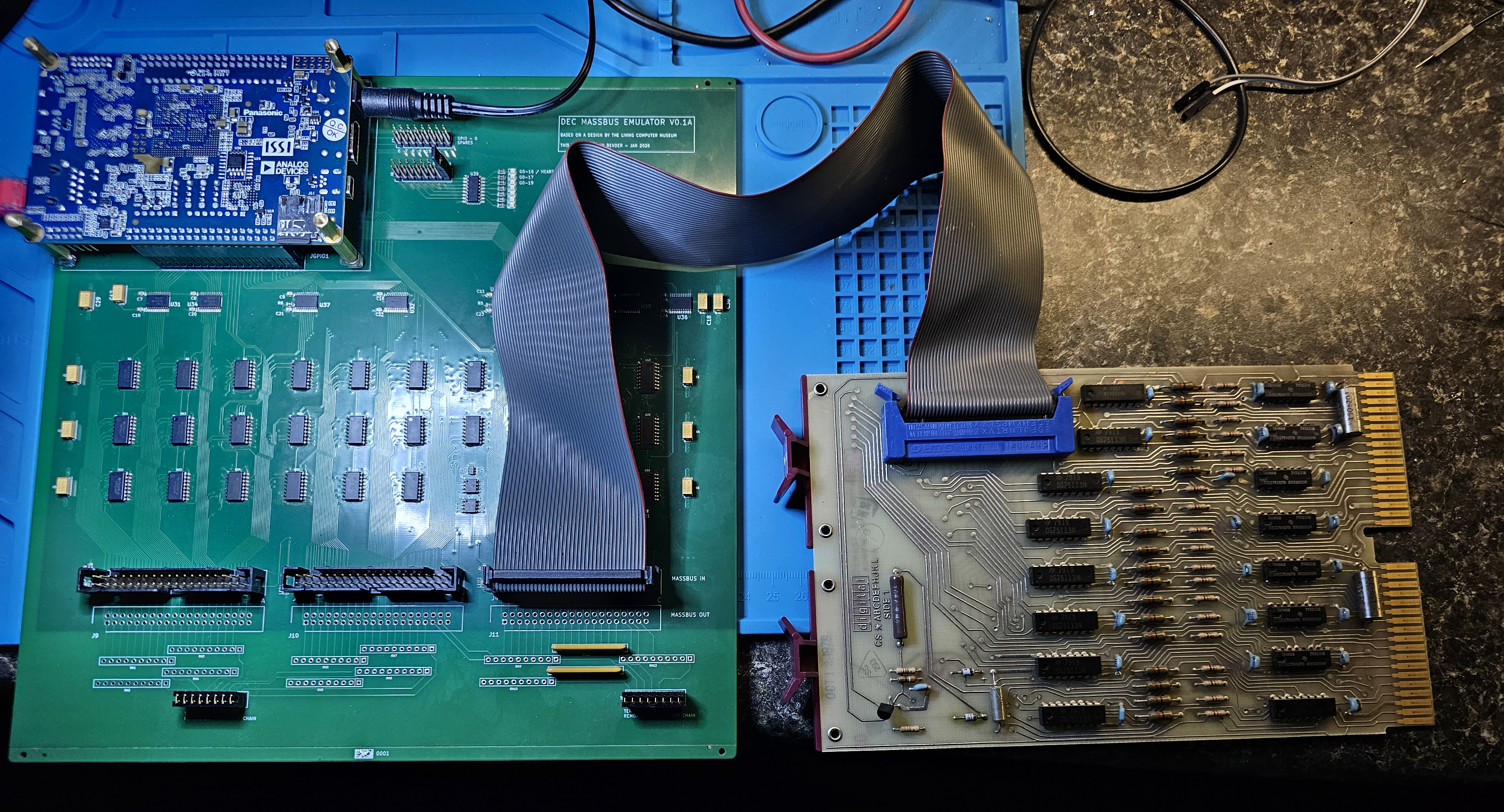
Current progress photo here:
http://www.dmv.net/mbe/mbe1.jpg
Why, you ask? "Has he gone insane?" are you thinking?
I have three PDP-11/70s that I would like to get running again. Sure, I could
cheat and hang a UNIBUS SCSI controller with a ZuluSCSI disk simulator, but
where is the fun in that? Also, the 11/70 was designed and optimized around
Massbus for primary storage, so it seems only fitting to use it that way.
The original LCM emulator used a PC with a Mesa 5I22 FPGA card as the Massbus
interface. The FPGA implemented the drive-side bus logic, while the PC
software emulated the backing disk or tape image. A driver/receiver (“D/R”)
board sat in the middle to translate the Massbus differential signals into
logic levels suitable for the FPGA. It worked...
Since Mesa 5I22 cards are now pretty much unobtainium, I went looking for a
cleaner and more modern approach. The result is a redesigned D/R board that
accepts a Terasic DE10-Nano directly. The DE10-Nano is a small Linux SBC with
a Cyclone V FPGA onboard, so it can host the emulator software itself while
the FPGA handles the Massbus interface duties that were previously done by the
Xilinx FPGA on the Mesa card. Same general architecture, but much tidier.
There is still work to do, but it is coming along nicely. The board in the
photo is not yet fully populated, since I am doing incremental testing before
committing the rest of the parts.
As I have gone down this rabbit hole, naturally a few questions in the “why
did they do THAT??” category have come up...
paging @Rich Alderson ...
If anyone here is still actively using Massbus, has experience with the
original LCM project, or just has relevant war stories, comments, warnings, or
encouragement, I would be glad to hear them.
Cheers!
Jim