8 Mar
2026
8 Mar
'26
4:42 p.m.
On Mar 8, 2026, at 5:18 PM, Holm Tiffe via cctalk
<cctalk(a)classiccmp.org> wrote:
<snip>
..so I have an working ring counter here next to me on a breadboard. :-)
There is still an MPSA42 used as an pulse former in the clock circuit
that I want to change agains a trigger tube. I need an Ide of an circuit
that gets triggered on approx. 30-40V and outputs an rectangle pulse of
lets say 60V and 10-30µs duration to properly trigger the ring counter,
using possibly only one trigger tube.
I think no one knows that for now..but I'm very grateful for links
to older literature on this topic.
approximately in 2000 I'm parted out old hp tube counters, the displays
where "thermometer Displays using 10 pcs. of neon lamps, one for each
number. The counters used 4 12at7 type "digital" tubes (don't remember
the exact type for now) with biquinary output to the neon lamps.
Later hp counter modules used the very same schematics and the neons and
one hybrid photoresistor module in front of the neons as decoder to
drive nixie tubes. I've tried it already in the past with the neon bulb
ring counters.. a cheap photoresistor in a balc schrink tube that was
put onto the neon lamp can switch a nixie..it works flawlessly.
Tried this on the TX4b .. works too. :-)
..other schematics ad an additional trogger tube for each nixie
cathode..the effort pretty much explodes...
Hope someone can help with some hints or links.
Regards,
Holm
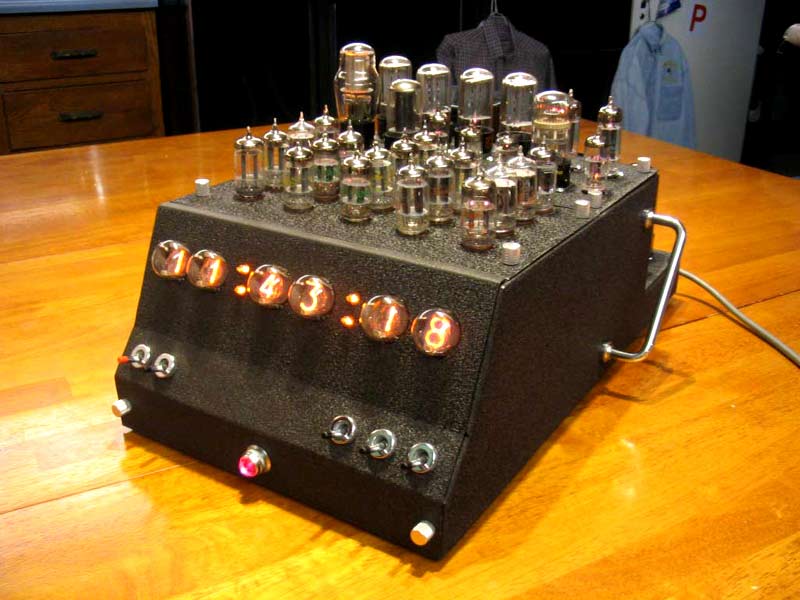
Hello Holm, I very much recall when Friedhelm completed his clock. Ironically, I was
building my own version in parallel initially unaware of his project. For mine, I used
Beckman modules which I modified for proper roll-over, and drilled out the “thermometer”
indicator fronts to mount CdS cells for the Nixies. The timebase was a dekatron
“Phantastron” circuit operating at 1 PPS. Black crinkle paint and IBM toggles with proper
trim nuts completed the package. A slightly lower power bill, but not by much, haha.
Here’s a 20+ year old photo.
https://linearlook.com/eldocountry/projects/tubeclock/tube1lrg.jpg
I have considered using neons in a ring circuit for a sequencer in my home-brew relay
computer, but will probably go a different direction. Some folks have had success, but it
requires much binning to get the desired characteristics for reliable operation. You were
curious about links, I highly recommend this one:
https://www.worldradiohistory.com/Archive-Catalogs/Suppliers/GHI/GE-Glow-la…
Best Regards,
Cory Heisterkamp