Excellent, that's a great start.
Vince - thanks for the measurements, I will redraw a better 3-view using those. Not sure about how the extra bolt goes though.
Ethan - thanks for confirming the different leg pad to frame pad.
Noel - that is extremely useful info on the pads, I've now found them at http://www.vlier.com/product_index/leveling/sel_05_lstar.html#
Paul - yes I noticed some systems had different legs, for instance this one https://c1.staticflickr.com/3/2435/3878202215_372c46fccb_b.jpg
and any p/n info you have from better sources would be welcome.
The part number I found for the legs (H-952-BA) came from the Fall 1978 Digital Sales Catalog, page 129 which has the same p/n for both
Standard and Short cabinets.
I'll cogitate over a revised drawing and get back to the list.
Thanks again,
Steve.
I regret we haven't been able to resusciate my 4051 yet.? Still kills power to the main board.
I didn't know there were games for the 40xx machines.? I didn't think they could with the limitations of the screen design, although I kinda thought the display would work well for, say, an adventure game.
B
Sent from my Samsung device
-------- Original message --------
From: Randy Dawson via cctalk <cctalk at classiccmp.org>
Date: 2018-01-06 10:01 PM (GMT-08:00)
To: Randy Dawson <rdawson16 at hotmail.com>, "General Discussion: On-Topic and Off-Topic Posts" <cctalk at classiccmp.org>
Subject: Re: Tek 40xx computer users
This was for Mike Hass, he was not in the email chain, and I do not have his address.
But it' s a general shout out to the other Tek 40xx users out there...
Randy
________________________________
From: cctalk <cctalk-bounces at classiccmp.org> on behalf of Randy Dawson via cctalk <cctalk at classiccmp.org>
Sent: Saturday, January 6, 2018 9:54 PM
To: General Discussion: On-Topic and Off-Topic Posts
Subject: Re: Tek 40xx computer users
Hi Gary,
Well its been a year.
Some news from here:
Micheal Cranford finished his MAXIPACK and FASTGRAPHICS PACK, and the results are awesome.
50-100% increase in the graphics speed, and he put all the demos and games on the MAXIPACK.
I 3D printed the plastic case for the PACKs and they look good.
I would like to see if we can work together, to clone the ROMs out of the packs you have, or see if you are willing to sell duplicates you have.
I really need a communications PACK, my 4051 did not have the comm port.? I have no way to transfer data in and out, I was going to attempt it over GPIB, bit I did not get very far.
What is new from your end?
I think we are trying to organize a 405x users group, I am talking with a few other guys.
Cheers,
Randy
________________________________
From: cctalk <cctalk-bounces at classiccmp.org> on behalf of Mike Haas <dogaschesswarrior at gmail.com>
Sent: Thursday, October 27, 2016 8:10 AM
To: General Discussion: On-Topic and Off-Topic Posts
Subject: Re: Tek 40xx computer users
Congrats on your new Tek.??? My 4051 pile came from came indirectly from
Gary Spence, who had inhouse involvement with the model. (can't locate his
bio at the moment)? Here's what I got... somewhere:
4051, 2x 4907 Dual 8" floppys, and the "System Test Fixture" front panel, a
box of DC300 tapes
"GAS 6800"? - a Homebrew 4051? (maybe a prototype?? 4051? ???)
and? these paks:
RS232 I/O compak
dual port memorypack
UNIBURN EPROM burner pack
VIDEOFRAME digitizer
GPIB Enhancement rompack
RS232 Printer Interface
Parallel Interface
Rompack Switch
Data Communications Interface
8k Rom pack
Addressable Data Tracking backpack
IC Analyzer
Editor Pack
Filemanager Pack
Binary Program Loader Pack
Signal Processor Pack
Service Pack
Pack extender board
a few empty packs and several wired edges
On Sun, Oct 23, 2016 at 10:15 PM, Randy Dawson <rdawson16 at hotmail.com>
wrote:
> I bought the Tek 4051 on ebay today; Jason brought it to my house and it
> works perfectly, with about a half hour of programming instruction my 12
> old daughter was plotting a cat face.
>
>
> https://www.facebook.com/Thelma.Franco/videos/10154277153852670/
Log In or Sign Up to View<https://www.facebook.com/Thelma.Franco/videos/10154277153852670/>
www.facebook.com
See posts, photos and more on Facebook.
Log In or Sign Up to View<https://www.facebook.com/Thelma.Franco/videos/10154277153852670/>
www.facebook.com
See posts, photos and more on Facebook.
www.facebook.com<http://www.facebook.com>
[https://www.facebook.com/images/fb_icon_325x325.png]<http://www.facebook.com/>
Facebook - Log In or Sign Up<http://www.facebook.com/>
www.facebook.com
Create an account or log into Facebook. Connect with friends, family and other people you know. Share photos and videos, send messages and get updates.
See posts, photos and more on Facebook.
>
>
> I would like to get in touch with other users of this first personal
> computer, and find additional resources.
>
>
> Do you know where I can find an archive of BASIC programs for this?
>
>
> Has anybody built plug in cards in the back, mine came with a realtime
> clock and a "file manager", I do not know what that one does.
>
>
> I have some Tek scopes with IEE-488, and I will see if I can get the IEEE
> interface working.
>
>
> There was a DC300 tape in the machine:
>
>
> biorithm
>
> craps
>
> blackjack
>
> artillery
>
> tanks
>
> weatherwar
>
>
> The belt is broken in the tape, I have ordered some new DC300's and will
> transplant the tape.
>
>
> Any resources will be welcome!
>
>
> Randy
>
>
>
>
>
I was given three VT100 and one VT131 in not great condition.
The biggest problem is that the keyboards are missing approximately 25% of
the keys in average. For example all SETUP keys and NO SCROLL keys are
missing. God know why.
It makes little point for me try to find keytops for these four keyboards.
Besides they are not actually matching the terminals except for one of
them. Apparently the VT131 keyboard is slightly different from the VT100.
Then two of the VT100 has a different first ROM chip and also an extra char
gen chip (23-108E2 and 23-198E2). Seems to be some kind of European/
Swedish/Scandinavian chargen and keyboard layout. The keyboards I received
has US layout.
I checked two PSUs, one monitor board, and one basic video (logic board)
which seem to work OK. One keyboard tested and is working electrically.
The cases are from OK to in quite ugly shape and the CRTs are from minimal
screen burn to quite some screen burn (due to long time with inverse video).
Is there interest in a full terminal? Parts? Keytops? I will probably keep
one or two flyback transformers to keep the ones I have going.
I am in Sweden.
/Mattis
From: Murray McCullough <c.murray.mccullough at gmail.com>
>
>This may be off-topic but these latest uprocessor exploits has raised
>a question: Are the 'old/classic' uprocessors using x86 technology in
>the same boat?
>
The exploit effects the speculative execution facility, so no it's not
"all P6 forward": nothing 32-bit or PAE, nothing just OOO, etc. The
current word I have (from my risk management folks, who got it from
Intel) is the oldest chips verified to be affected are the Xeon 3400
(server) and 2nd Gen Core (desktop) processors. So, probably nothing
later than 2009 or so.
KJ
Hey Alex,
I was trolling the internet and came across you post from 2015!! I have a
GRiD 2260 in like new condition with all the attachments, software and
carrying case. Are you interested?
Thanks,
Dan Smith
dansmithmaryland at aol.com
410-841-4827
Hello,
I have some doubt about DEC tape units and related interfaces.
What I know about (right or wrong, please correct):
- TU80 is a Pertec drive, it needs M7454 (unibus, TS11 driver) which is a
modified Dilog DU132. No option for QBUS.
- TS05 is a Pertec drive, it needs TSV05 (qbus, TSV05 driver) which is a
modified Emulex ???)
- TU81 plus is LESI or Pertec, you need KLESI (unibus / qbus, TMSCP driver).
Now the questions:
I have both a TU80 and TU81plus, and both Unibus and Qbus machines, but no
interfaces.
I would like to connect at least TU80 to unibus, and TU81 to qbus, but for
backup reasons it would be better to have both drives on both busses.
What are the DEC or third party card which would fit better on my drives,
and/or which would offer better driver compatibility with various OSs (via
switchable configuration).
I'm not sure about interface compatibility (Pertec interfaces could be
swapped),
and driver compatibility (what is better for RT11, what for BSD, what for
VMS).
I would accept also some offer to my email, if somebody has something
interesting to sell (better if in EU).
Thanks
Andrea
This may be off-topic but these latest uprocessor exploits has raised
a question: Are the 'old/classic' uprocessors using x86 technology in
the same boat? The very earliest ones, i.e., 1970s and early 80's.
probably not. How many are actually in use and/or on the Net?
Happy computing!
Murray :)
Hi My Friends,
Just a quick message to let everybody know that I am starting IT Training
Monday, January 8, 2018 to get the certifications I need. When finished I
plan to have my A+, N+ and S+ certifications. For those unfamiliar with
these certifications, this is paper work proving I have the knowledge to
perform the tasks of a Computer, Network and Server Technician in that
order. These enable me to get the great jobs in IT that I am looking for.
That is my plan. Please keep me in your prayers. This will be a lot of
work, reading, labs etcetera. In December 2018, I ought to be getting a
great Christmas present! :D
I will be checking my email when I can. Take care my friends.
>> From: Jim Stephens
>> I had a meeting with Ken Omohundro on 12/7 and will be having dinner
>> with him again soon. I'll ask him about it. I know he doesn't have any
>> records left, but I could take him your notes and see what he recalls.
> Thanks very much for that offer; we do think we know more or less how it
> works
So, I have completed what I think is a pretty thorough article on the CHWiki
about the ENABLE:
http://gunkies.org/wiki/Able_ENABLE
It contains _everything_ I was able to glean from the still-extant
documentation, etc, which I have access to.
There is enough detail there to add support for it to SIMH/Ersatz-11 (hint,
hint :-).
> there are two areas in which he might be able to help.
> The first is some very low-level details of how it worked, in terms of
> the UNIBUS interaction ... I _surmise_ that it was something like it
> watches NPR/SACK for a DMA cycle .. then waits for BBSY to cycle, at
> which point it knows it's a DMA cycle
Having refreshed my memory of how DMA cycles worked, I suspect it just watched
SACK and BBSY (since technically a UNIBUS device can do DMA cycles after
grabbing the bus with BRn), so no need to watch NPR.
> The second is some details of how some of the optional stuff for using
> existing memory, non-DMA devices, etc worked. ... I'll have to go
> re-read the documentation
Having looked again, I don't think there's any mystery; probably I just hadn't
carefully read it before.
One question I do have, though: why the limit (per the documentation) to 128KB
of old memory? If I'm correcly understanding how the MemDap works (it
apparently makes the address space of the 'secondary' UNIBUS appear on top of
the EUB memory, on the EUB) it should be able to handle up to 248KB? (The top
8KB is the I/O space on the secondary UNIBUS, which, if devices on the
secondary UNIBUS are to be supported, must be visible to the CPU through the
ENABLE.)
> It would also be interesting to know why he just didn't use a 3-bus
> design .. I suspect that the answer is that they way they did it, they
> could use a stock MUD backplane ... and only one over-the-back [UNIBUS]
> connector into the ENABLE [there probably wasn't room for a second].
This too.
>> I hope to get a biography and history of his companies including Able,
>> and figure somewhere to get it stored.
> The Computer History wiki would seem an ideal place for this sort of
> content?
Reaction?
Noel
This should be public, so visible even if you don't have a FB login.
https://www.facebook.com/jserwach/posts/1804323786269276
--
Liam Proven ? Profile: https://about.me/liamproven
Email: lproven at cix.co.uk ? Google Mail/Hangouts/Plus: lproven at gmail.com
Twitter/Facebook/Flickr: lproven ? Skype/LinkedIn: liamproven
UK: +44 7939-087884 ? ?R (+ WhatsApp/Telegram/Signal): +420 702 829 053
For some time now I have had a couple of ZX Spectrum machines. Neither
works, each has a different problem. Today I got one of them out for another
look. The problem with it is that it seems to constantly reset itself, you
see the copyright screen briefly and then it disappears (the TV screen shows
the usual "snow" when there is no signal). It just cycles round doing this.
I put a logic analyser on it as well as a scope. The CPU Reset pin looks
fine, it goes high and stays high.
The logic analyser shows that it is happily reading code from the ROM during
the boot sequence and it will suddenly start fetching instructions from
address 0 again, this appears to be somewhat random. I don't have a lot of
experience with logic analysers, and I have found that some pod/probe
combinations cause the machine not to work at all, so the logic analyser is
not, unfortunately, above suspicion. However the behaviour I see appears
consistent with what the logic analyser is telling me.
My thoughts are that this must either be a bad Z80 CPU or a bad ROM. Neither
is socketed and I am reluctant to desolder ICs unless I really have to as
there is always a risk of damage to the board.
Has anyone seen a similar problem before? Could this indeed be the CPU or
the ROM, or could there be a different cause?
Regards
Rob
Hello PDP-11 crowd:
I?m thinking of starting a project that will interface to a DR11-C, which has the usual 40-pin Berg ribbon cable connectors. I thought I?d ping the collected wisdom here to see if other folks had already sourced an available modern cable connector for this that they particularly like?
cheers,
?FritzM.
Even though I've been quiet, I have been making slow progress on the
QSIC in the background.? For those who've forgotten what the QSIC
project is about, here's the description:
http://pdp10.froghouse.org/qsic/html/overview.html
We've been working away on getting communications with the SD card
working and that's basically there now.? It initializes and reads and
writes blocks.? I've also connected it through an async FIFO to the
minimal RK11 controller I had working before and that's mostly working.?
That is, it can read and write blocks under control from the QBUS PDP-11
as if it were a real RK11/RK05.? What more could you ask for?
Well, I could ask for a lot more really but that's pretty good.? There's
a lot of RK11 functionality that I haven't implemented yet and all sorts
of configuration options we need to get in there.? Also, there's a bug
where it sometimes scrambles data so it's not quite ready to boot and
run a real OS yet but it's getting awfully close.
Here's a picture to my test setup:
http://pdp10.froghouse.org/qsic/qsic-setup.jpg
And a picture of a test of some spray-on glass frosting used as a light
diffuser on the indicator panel.? In this picture you can also see the
new LEDs I found that are a much better color match to the old
incandescent bulbs than the LEDs I picked for my first attempt.
http://pdp10.froghouse.org/qsic/frosting.jpg
Now for the request.? I've decided that I'd like to put a soft-processor
in the FPGA to handle a bunch of things (configuration duties and the
USB protocol being two of the big ones).? My preference would be for
this soft-processor to be a PDP-11.? Surely there's hack value in using
a PDP-11 as the I/O processor for a PDP-11 but there are practical
advantages to this as well.? For one, we're already familiar with it and
have a suite of development tools.? Also, I can re-arrange the I/O
devices I intend to give to this soft-11 and put them directly on the
QBUS instead and do initial development there.
I'd rather not get diverted by yet another substantial development
project so I'm looking for a decent little FPGA implementation of a
PDP-11 that I could just pick up use for this purpose.? Something that's
already debugged.? I'm thinking closer to an 11/04 than an 11/70 and
likely just running out of block RAM on the FPGA.
Thanks for any pointers to such an implementation and thanks to everyone
who's given support and assistance as Noel and I have poked along on
this project.
Dave
> From: Ethan Dicks
> The rod is also smaller by quite a bit, but I don't have one in front
> of me to measure.
The two feet are quite different. The smaller one on the extender is 5/16"-18
(i.e. UNC Coarse thread); the larger one under the cabinet is 1/2"-13.
Replacements can easily be had from Vlier: Vlier part numbers are FSE302S
(for the extender feet), and FSE306S (for the main feet).
We really ought to do a group bulk build of the extension castings; if we get
a reasonable size order together, they shouldn't be that expensive. Ditto
for the special bolt needed to hold them to the H960.
Noel
I'm in need of some feet for my H960s and am intending to make a few pairs, so I thought I might
as well try and make them look close to the originals.
I have a few ideas on construction, for instance 3mm steel plate laser-cut and folded jigsaw fashion
then welded, or even simpler a basic welded steel bar with a 3D printed leg cap for asthetics.
I've been unsucessful in finding any closeup photos or drawings of these things so have used a diagram
>from one of the 11/70 manuals which is the best I have so far. Thankfully they drew it in isometric so
it was easly to overdraw in CAD and project it to this:
http://web.aanet.com.au/~malikoff/pdp11/DEC_H960_stabiliser_foot_left_A-H95…
I have some questions-
Does the (optional?) sheetmetal kickplate play any role in securing these legs to the frame?
Are the two front screws are only there to hold them on and there is some internal box section that goes
into the front of the channel on the rack to take the weight?
Is the outer side tapered? It looks straight.
If the foot a one piece casting (presumably) or fabricated in some way?
Is the foot pad thread in the centre of the front of the leg, and is it the same thread and pad as the H960?
Finally I would really appreciate if someone could run a digital caliper over one, and fill in my required
measurements A through Q in the above drawing. And if you have a radius guage that would really be great.
As usual, thanks for any help or advice.
Steve.
Just curious...can anyone id the system that used these two types of core
memory? I am thinking the first is a hand-made custom core, but the 2nd is
definitely from a commercial system. Looks kind of IBM-ish but it's
nothing I can ID. It's not an IBM 1401 I don't think.
http://vintagecomputer.net/core-memory/
Thanks
Bill
> From: Toby Thain
> If the documentation is good enough, people in the community will be
> able to provide the software.
You mean, host drivers?
Yeah, that documentation will be pretty trivial: 'there's this extra
register, just like the one in the RLV12; the top 6 bits of the DMA memory
address go in there - the bottom two bits are mirrored into the two extended
memory bits in the CSR'. For the 'extended' RP11, not much more than that.
If you mean the 'software' for additional controllers - that would be a _lot_
harder (plus to which it's an entirely different tool-chain, yadda-yadda).
'Use the source, Luke!', I'm probably afraid...
Noel
Hey everyone, Happy New Years!? I am thankful for an active community
that enjoys helping each other learn, and today I am coming with an ask
for help.
I have a SWTPC 6800 and ADM3A terminal, I can get it to boot, and when
it boots it will continue to boot for several hours.? But getting it to
successfully boot takes upwards of 100 power OFF and ON cycles.? The
other 99 times, I get a continuous stream of random ASCII characters
(see video link below).? It's my first time seeing this type of issue
that happens intermittently, and wondering if anyone has any insights in
what might be causing this.? I suspect its a faulty IC on the Processor
board that resets or controls the OS reset, will need to deep dive and
diagnose, but thought I would ask for some direction first.
https://www.youtube.com/watch?v=Ci4vhPn-3PE
Thanks in advance!
-Nick
Hi, I'm brand new to vintage computing and would love any advice. I'm
thinking of putting together a SM EVM A131-10 and would appreciate any
advice/knowledge on the unit.?
Just posting this here in case it reaches eyes not in other forums I'm on.
I decided to embark on a project that involves burning a 2708 EPROM. I've
never messed with EPROMs before, so I decided to practice. What I have is a
Microworks 2708 'burner' that came with a SWTPC 6800 machine I have. I
figured I'd start by learning how to read 2708s.
I only had one 2708 lying around to use. It was installed on a homebrew
'Dynamicro' board (also known as Jon Titus' MMD-1). It's strange because
the MMD-1 doesn't use 2708s. This board also had a bunch of ICs on it that
are not what the MMD-1 design calls for. So I thought this'd be an
interesting EPROM to read anyway, since it might yield a hint as to what the
builder was doing with this board, or if they were just using it to store
random ICs.
Anyway, I fired up the 6800 with the chip in the ZIF socket of the
Microworks board and read the contents into memory. I then punched it back
out to my PC terminal as S records. That's as far as I got. I'm wondering
now how to actually dig into the contents a bit for clues as to what it is.
I've seen posts in the past from people who were able to find strings, etc
that sort of help as clues. Does anyone know how I'd go further here?
Really curious what was on this one.
Thanks!
Brad
> From: Paul Koning
> The only asynchronous computer I can think of is the Dutch ARRA 1
Isn't the KA10 basically asynchronous? (I know, it has a clock, but I'm
not sure how much it is used for.)
The thing is I recall reading (where, I don't now remember) that the CPU is
organized with 'go' pulses leading from one block of circuity to another, and
it uses delay lines to time out the passage of these pulses, so if you wanted
the CPU to be as fast as possible, you went around to each delay line and
tweaked them down until things started to fail, and then backed off a bit.
Other CPUs of that era might be the same. There's an amusing description
of the Multics CPU here:
http://www.multicians.org/mga.html#6180
"The 6180 processor was among the last of the great non-microcoded engines.
Entirely asynchronous, its hundred-odd boards would send out requests,
earmark the results for somebody else, swipe somebody else's signals or data,
and backstab each other in all sorts of amusing ways which occasionally
failed (the 'op not complete' timer would go off and cause a fault). Unlike
the PDP-10, there was no hint of an organized synchronization strategy:
various 'it's ready now', 'ok, go', 'take a cycle' pulses merely surged
through the vast backpanel ANDed with appropriate state and goosed the next
guy down."
Noel
> From: Mark J. Blair
> I wonder if it might also be useful in any of the QBUS MicroVAXen?
Hardwarewise, it should be fine. Softwarewise... well...
The issue is that we're currently only planning to emulate the RK11 and RP11,
because we're not up for the hassle involved in emulating more recent
controllers. (That's not an issue for the systems we want to run.)
We looked at the RP04, and _full_ emulation even of that one is a significant
amount of work. (I stress the 'full' because a partial, simple emulation
might not be too bad, but since we have no idea what various OS's will expect
to be there, it's not clear how much use such a partial emulation would be.)
However, that presents a problem. There are no 22-bit versions of either (in
fact, there's no QBUS RP11 at all; and the QBUS RK11 is restricted to Q16,
for reasons that surpass me). 22-bit operation is needed to make them really
useable as mass storage under Unix, for swapping (because all file system
access is buffered through low memory, purely file system use would be OK
without Q22 support) - at least on -11's with more than 256KB of memory.
(Probably DEC OS's too, but I know nothing of them.)
So, in addition to the dead-stock emulations of the two, we will also support
slightly 'adjusted' versions of the controllers, to have an 'address
extension' register (in exactly the same way the RLV12 has an extra register
over the RLV11).
(And we're also going to have an adjusted version of the RP11, which extends
the size of the disk, using unused bits/values in the disk address registers,
to allow up to 1TB on an 'RP11-D', as we're calling it. Hey, if you're going
to change the controller _at all_... But I digress.)
Anyway, you can see where this is going. For people who can tweak their
drivers, no biggie. The changes aren't major - a line or two. For people who
want to run stock software...
I don't know enough about how the QBUS VAX systems use their disks. Will uVAX
OS's run with only an RKV11-D for mass storage? Somehow I doubt it..
I assume on the later ones (the ones with the private memory bus so they can
have more than 4MB of memory) there's some sort of QBUS map, to map from the
QBUS' 22-bit address space, to the full memory. But does the hardware and
software expect to use the entire 22-bit address space, or are they prepared
to limit it (e.g. for working with an RKV11-D), or what?
I suppose we could add the RLV12 to the list of things we emulate; that's not
_that_ complicated a controller. The problem is that RL's aren't that big
(10MB), and that gets to be an issue with later OS's. And even then VAX OS's
might not run off an RLV12 - I just don't know.
Getting around this is all, of course, a SMOP (Small Matter of Programming),
since a new FPGA load, with support for more emulations, can be installed on
an existing QSIC at any time.
Now, whether Dave would be interested in supporting later devices, or whether
someone else could be convinced to emulate something more modern ... who knows?
Noel
> From: John Welch
> SAV -- SOFTWARE CONFIGURED FOR ENABLE HARDWARE WHICH DOES NOT RESPOND.
> HALTED.
> Does anyone have any hints on how I can guess what I need to add?
Well, Able made a thing called an 'Able ENABLE' which allowed use of more
than 256KB of physical memory on any UNIBUS -11 with memory mapping hardware
which wasn't an -11/70-44-24. That's probably what it's talking about.
We had one on our -11/45 at MIT, BITD. So I have the programming spec for it,
back-created from the source code for that machine. And Clem Cole was nice
enough to follow up on an old message in an email list archive, and dig up
some documentation and scan it in.
I was planning on doing a page for it on the Computer History wiki, haven't
got a round tuit yet, though.
They are, AFAIK, complete unobtainium in physical form; I've been looking for
years, never seen one.
If someone wanted to upgrade SIMH to support it, we do know enough to do that.
Noel
> From: John Welch
>>> SAV -- SOFTWARE CONFIGURED FOR ENABLE HARDWARE WHICH DOES NOT RESPOND.
> I can boot RSX from a different device (or RT-11, or unix maybe) and
> then mount this RL02 pack and go exploring through its contents. Is
> there a possibility that I may find what is missing that way?
Sorry, I'm confused by this? The message (above) seems to indicate there's
_hardware_ missing. How is looking through the disk contents going to help
with that?
Or is your point that you might be able to find a version of the system which
does not use that hardware? Perhaps; there's no way to know without looking.
Noel
Best wishes for 2018!
I have been busy trying to repair my dead 11/35.
The system was working, but there was one screw loose that mounts the
system units in the BA11 box ... that screw created a short circuit :-(
After powering the 11/35, ENA/HALT on HALT, and toggling the LOAD ADRS
switch, all DATA lamps go on, and after that the machine is totally
non-responsive.
I installed the KM11 replica from Guy Sotomayor (at last, after 7 years,
I have soldered one of the kits that I had since 2011-2012!). With the
KM11, I can step the microcode right from power up. When I toggle
LOAD ADRS I see that the SWITCH signal (via the 7474 flipflop) is set,
but when the microcode checks *which* toggle was activated it decides
that none was activated. I measured the signals that play a role here,
and all looks fine.
Now, what gets me puzzled.
If I toggle the LOAD ADRS switch *and hold it pressed down*, then, when
I step the microcode, the branch that handles the LOAD ADRS switch
actually does get executed, and the ADDRESS lamps on the console show
the switch register settings.
Anybody for clues how to proceed?
If you are interested, I made a write up of my testing in (way) more detail:
www.pdp-11.nl/pdp11-35/repair/repair35page.html<http://www.pdp-11.nl/pdp11-35/repair/repair35page.html>
Thanks for any advice,
Henk
> From: Jim Stephens
> I had a meeting with Ken Omohundro on 12/7 and will be having dinner
> with him again soon. I'll ask him about it. I know he doesn't have any
> records left, but I could take him your notes and see what he recalls.
Thanks very much for that offer; we do think we know more or less how it
works (software-wise we always knew, since I wrote the code for it on the MIT
system, and that, and some other code to run it, still survive; the hardware
details had faded from my memory, but the documentation that Clem Cole found
cleared the high-level details of that up, mostly); however, there are two
areas in which he might be able to help.
The first is some very low-level details of how it worked, in terms of the
UNIBUS interaction; we can surmise, from the way it's installed, how it more
or less has to work (details below), but it would be nice to have it
confirmed. The second is some details of how some of the optional stuff for
using existing memory, non-DMA devices, etc worked. (I honestly forget the
details of what I couldn't work out there; I'll have to go study it again.)
The first is that unlike my initial recollections, both the CPU and DMA
devices are on a single UNIBUS segment which feeds into the ENABLE. There are
two different 18->22 maps in the ENABLE, one for CPU cycles, one for DMA (the
latter perfectly emulates the UNIBUS map on the -11/70 and /44). So, more or
less by definition, it has to be able to distinguish CPU bus cycles from DMA
device bus cycles on the incoming UNIBUS segment.
But how, exactly? I can _theorize_ how it did it, but this is a topic not
covered in the still-extant documentation. I _surmise_ that it was something
like it watches NPR/SACK for a DMA cycle (it won't see the NPG, of course),
then waits for BBSY to cycle, at which point it knows it's a DMA cycle; if
not, the current cycle must be from the CPU. He may or may not remember the
details, but if he can, that would be great.
(For software emulation, we don't need to know this, but it would be good,
for completeness' sake, to know. Also, I have a fantasy that the UNIBUS
version of the QSIC will also include ENABLE-type functionality, and although
we could probably work it out on our own, it would be good to have the
benefit of anything he can recall - any not-so-obvious gotcha's, etc.)
It would also be interesting to know why he just didn't use a 3-bus design:
i) UNIBUS in from the CPU, ii) UNIBUS in from DMA devices, and iii) EUB to
the memory. I suspect that the answer is that they way they did it, they
could use a stock MUD backplane (being used in EUB mode), and only one
over-the-back connector into the ENABLE.
On the second, I'll have to go re-read the documentation, and get back.
(Although now that I think about it, I may have just figured out, not only
the question, but also the answer.)
> I hope to get a biography and history of his companies including Able,
> and figure somewhere to get it stored.
The Computer History wiki would seem an ideal place for this sort of content?
(Depending on how long the bio is; but the company info would _definitely_ be
very much on target for there.)
Noel
There probably aren't that many 120V versions of the Amstrad Joyce Word
processor, but I've got one here. I replaced the 3" CF floppy drive
with a 720K 3.5" drive and modified some boot disks.
The system now supports 3.5" double-sided media and is fully populated
with 512K of DRAM and runs CP/M 3.0.
Unit with keyboard only, free to good home; sorry but I don't have the
printer.
I need to get this thing out of the way; if it goes unclaimed by January
15, off it goes to NextStep recycling.
--Chuck
Did anyone ever succeed in repairing a stepper motor
Currently restoring a datapoint floppy drive that has been stored in a disastrous environment.
The head stepper has a loose wire, currently I cannot even see how to open the stepper motor.
It is a Warner Electric SM-024-0045-AS
Cannot see any marking as to who the druive supplier is, it might have been Datapoint themselves.
Jos
Anyone have one of these single board embedded computers in use? I have
one that is unresponsive and I believe I need to replace the Dallas battery
chip, similar to other computers like the SunSparc 10 that does nothing
without a working NVRAM battery chip installed.
Any opinions/experience with this card out there? I have already ordered a
new battery but while I wait I'd like to throw this one out there. Its from
the later 90's not yet "vintage" so that's why the header semi OT.
http://www.voxtechnologies.com/SBCs/pdf/icp/rocky-518hv-ver4-0.pdf
Bill
Seeing Noel's blinkenlights project and list of panels, for interest's sake here is a picture and
decription of the Foxboro drum indicator panel from one of the hardware manuals.
http://web.aanet.com.au/~malikoff/foxboro/FOXBORO_Drum_indicator_panel_1.jpghttp://web.aanet.com.au/~malikoff/foxboro/FOXBORO_Drum_indicator_panel_2.jpg
There was no trace of any panel nor drum when I recovered the Foxboro 2/10 (PDP-11/15) but I did
find the print set for the above panel (schematics only, no panel hardware details), and a set of
RC11 modules (6 flip chips) wrapped with an error list printout. I'm not even sure if there was a
drum fitted, as none of the notes I found for the actual installation mention it.
There was no other drive in the rack when I got there, so I'm baffled as to what device the cards
went to.
Steve.
> From: David Bridgham
> I could ask for a lot more really but that's pretty good.
IMO we're 'over the hump' on the prototype phase of the project. The complete
QBUS interface (including DMA and interrupts) are done, and very thoroughly
tested, and now we have the SD interface up and running too. Once we get all
this running reliably, IMO the remaining work (configuration, simulating the
RP11, etc) will be relatively simple and straightforward.
Then we get to the next major lump - turning out the production unit.
> Here's a picture to my test setup:
Looking at that brings up another piece of progress to report; that paper
version of the indicator panel inlay is just about obsolete; we have produced
blank inlays (the correct shape to fit into the bezel, but with just the back
black layer with all the holes), and the next move is to produce ones with
the white captions silk-screened on the front, just like the originals:
http://ana-3.lcs.mit.edu/~jnc/tech/DECIndicatorPanels.html
So 'very soon' we should have a complete working indicator panel!
A lot slower, overall, than we had hoped, but we're getting there!
Noel
I had that happening on mine.. came down to a bad RAM board.
Sent from my Samsung device
-------- Original message --------
From: Nick Allen via cctalk <cctalk at classiccmp.org>
Date: 2018-01-01 10:32 AM (GMT-08:00)
To: cctalk at classiccmp.org
Subject: Help diagnosing boot issue SWTPC 6800
Hey everyone, Happy New Years!? I am thankful for an active community
that enjoys helping each other learn, and today I am coming with an ask
for help.
I have a SWTPC 6800 and ADM3A terminal, I can get it to boot, and when
it boots it will continue to boot for several hours.? But getting it to
successfully boot takes upwards of 100 power OFF and ON cycles.? The
other 99 times, I get a continuous stream of random ASCII characters
(see video link below).? It's my first time seeing this type of issue
that happens intermittently, and wondering if anyone has any insights in
what might be causing this.? I suspect its a faulty IC on the Processor
board that resets or controls the OS reset, will need to deep dive and
diagnose, but thought I would ask for some direction first.
https://www.youtube.com/watch?v=Ci4vhPn-3PE
Thanks in advance!
-Nick
> From: Peter Corlett
> since we have computers with multiple gigabytes of RAM, it makes little
> sense to restrain one's use of them to a fraction of the capabilities,
> except as an intellectual exercise.
For data, sure. (It's amazing how big even images can become, as the
resolution is increased. And that's not even video!)
For code, however, there are very good reasons to think that 'more is _NOT_
better'. More code means more complexity, and that has a host of Really Bad
consequences: harder to understand, more likely to have bugs, etc, etc.
It also often means that unless you have the Latest and Greatest hardware,
the machine is simply too slow to run the latest bloatware. The machine I'm
typing this on has a 1.4GHz single-core CPU, and _most_ things run on it just
fine - but going to many Web sites is now painful, since the 'obligatory'
HTTPS (another hot button, one I'll refrain from hitting right now, to keep
the length of this down) makes even simple Web operations slow.
Noel
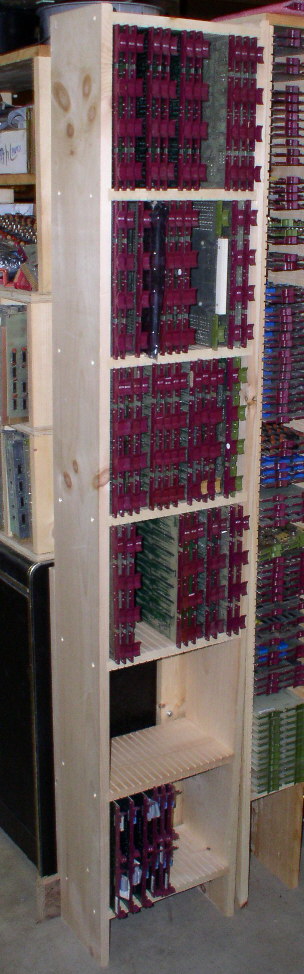
So, I've been making wooden racks to hold a lot of my DEC boards, and I've
finally come up with a nice design for one, which holds quad boards:
http://ana-3.lcs.mit.edu/~jnc/tech/jpg/QuadRack.jpg
which holds them vertically.
It's much better than the dual rack next to it, which holds them
horizontally, which has the issue that the distance between the sides needs
to be absolutely perfect, otherwise the boards tend to drop out of their
slots. With the boards held vertically, it's much less sensitive.
If anyone's interested in building one, I can whip up a drawing. (Note that
the slots are offset slightly to the left because one needs different
clearances for the solder and component sides.)
The one shown uses 3 pieces of 1"x8"x6' (not sure what that translates to in
that new-fangled French stuff :-). It would be tricky to make without a
radial-arm saw, though - although I suppose a router with a small bit could
be used, albeit tedious.
Noel
> From: Michael Zahorik
> a dozen or so spare boards for my PDP8E. I was wondering about how to
> store them. Some guys recommend some poly bags, others say it is
> important to protect against humidity. ... have you had any failures
> while in storage?
Well, i) most of my boards had been in uncertain storage for a long time
before they got to me, and I've only tested a fraction of them, so if I tried
one now, and it had an issue, I wouldn't know when (i.e. under which storage
regime) it happened - some have shown failures, but I think they all happened
before they got to me; ii) some of the failures we see (e.g. PROM's losing
their programming) are known to happen via various time-related processes,
not storage condition; and iii) I'm not a hardware person, but even then,
you'd want someone with expertise in failures, which is not common.
But, having said that, these are my 'common-sense' rules for storage: i) bags
aren't critical (especially for older stuff, which is generally bipolar, not
CMOS, and therefore not very sensitive to static), ii) high humidity is not
good, as you can get corrosion on chip leads (I've seen a few where the leads
were so corroded they came off)- but very low humidity can be an issue, if
you have CMOS, as it's more static-friendly (as Dave Bridgham found out the
hard way in his lab); iii) large-amplitude temperature cycles are not good,
as thermally-induced contraction and expansion probably aren't good; and
avoiding very high, and very low temperatures (even if constant) is probably
better for long-term health.
Noel
Hello,
With the wonderful help of many you here I have revived a PDP11/04,
connected it to an RL02, and using PDP11GUI I have successfully imaged a
number of RL02 packs.? I found a copy of an RQ device that boots.? I can
attach my images and explore the contents with PIP so I believe the
transfer was good.
One of the packs was a system disk so I tried to boot it like this:
?? PDP-11 simulator V3.8-2 (JH stdio telnet)
?? sim> set cpu 11/93, 4M
?? Disabling CR
?? Disabling RK
?? Disabling HK
?? Disabling TM
?? sim> set cpu idle
?? sim> set rl0 rl02
?? sim> attach rl0 RSX11-bu.rl02
?? sim> b rl0
?? SAV -- SOFTWARE CONFIGURED FOR ENABLE HARDWARE WHICH DOES NOT
RESPOND.? HALTED.
?? HALT instruction, PC: 126272 (BR 126270)
?? sim>
Does anyone have any hints on how I can guess what I need to add? The
original machine was and 11/34 (maybe a 11/34a) and had a multi-line
serial port setup.? All thoughts appreciated.
Sincerely,
John Welch
:qw
Hi,
I was working 1976 as a volunteer at a research center near Vienna in
Austria writing FORTRAN programs on a PDP8a. We also have a PDP8/e there.
Now I am collecting DEC stuff.
Happy new year !!!!!!!!!!!!
Gerhard
-----Urspr?ngliche Nachricht-----
Von: cctalk [mailto:cctalk-bounces at classiccmp.org] Im Auftrag von
cctalk-request at classiccmp.org
Gesendet: Sonntag, 31. Dezember 2017 19:00
An: cctalk at classiccmp.org
Betreff: cctalk Digest, Vol 39, Issue 30
Send cctalk mailing list submissions to
cctalk at classiccmp.org
To subscribe or unsubscribe via the World Wide Web, visit
http://www.classiccmp.org/mailman/listinfo/cctalk
or, via email, send a message with subject or body 'help' to
cctalk-request at classiccmp.org
You can reach the person managing the list at
cctalk-owner at classiccmp.org
When replying, please edit your Subject line so it is more specific than
"Re: Contents of cctalk digest..."
"Message: 4
Date: Sun, 31 Dec 2017 10:35:18 +1100
From: Nigel Williams <nw at retrocomputingtasmania.com>
To: "General Discussion: On-Topic and Off-Topic Posts"
<cctalk at classiccmp.org>
Subject: Re: Computing from 1976
Message-ID:
<CACCFpdyNiS2tCog38CbrHm2BuTAY=wh4PAJRZ0-Gz0z=0=9t4A at mail.gmail.com>
Content-Type: text/plain; charset="UTF-8"
On Sun, Dec 31, 2017 at 9:57 AM, william degnan via cctalk
<cctalk at classiccmp.org> wrote:
>> what magazine?
https://books.google.com.au/books?id=7wAAAAAAMBAJ&pg=PA82
note.
Popular Science Dec-1976
***
Thanks Nigel. I apologize to all for not putting this magazine name in
my original note.
I've been thinking this New Year's eve about the world of classic
computing: How far has personal computing actually advanced? Not
talking about computing on the Net or such. Just plain computing! Or
is there such a thing the last day of 2017?
Happy computing for 2018.
Murray :)
I've been experimenting with the SIMH VAX simulators a lot lately. The only way I know of to mount a tape, disk pack, CD-ROM, etc. after boot time is to halt the simulation with ^e to get to the SIMH command prompt, ATTACH the desired image, and then resume the simulation with CONTINUE.
Is there any way to attach/detach media images in SIMH without halting the simulation? I've tried putting the system console on a telnet port so it doesn't occupy SIMH's controlling terminal, and I found that it's still necessary to halt the simulation to get back to the SIMH command prompt.
--
Mark J. Blair, NF6X <nf6x at nf6x.net>
http://www.nf6x.net/
Are any of you aware of an MTS mailing list that lives outside of the
execrable Yahoo groups environment? And if not, is there any interest in
starting one?
Meanwhile, if there are any MTS hacks on the list, I have a question:
When running *SAV or *SVW, what are the labels the system is expecting for the
FSnnnn tapes? I tried the obvious - FS2001 for the FS2001 tape prompted
for - but no luck there. Then again, maybe I'm not labeling the tapes
properly.
This is under Hercules.
hetinit -d fs2001.aws FS2001 MTS
doesn't cut it. I also tried running *lbh against that tape (to give it the
same label), but no luck there, either.
The MTS operator's guide doesn't have anything to say about daily/weekly
backups, other than the cryptic notes on the *SAV and *SVW files, and I can't
find anything else as I dig through the rest of the online system docs.
$HELP ?
--lyndon
Hi,
A friend, probably in Ohio, tells me his father has 3 boxes (about 150
pounds)
of manuals for VAX/VMS and IBM 360 from the mid 1980s.
If anyone's interested in following up, email me and I'll send you the
contact info.
thanks, and Happy New Year!
Stan Sieler
I'm actively working on show planning for VCF PNW and I'm noticing that we
have a few international travelers planning to attend and exhibit their
machines/projects. I'd like to put together a FAQ for the logistics of
traveling with vintage equipment across the US border. If you have ideas
please let me know.
For example: Should I plan on providing letters in advance stating that a
person is a registered exhibitor at our show, including details like the
show location, dates, times, and contact information in case there is a
question about why somebody is carrying strange looking equipment into the
US? Is there any sort of paperwork or customs form needed even if nothing
is being sold or left in the US? Any other gotchas to look for?
Thanks,
Mike
> From: Paul Koning
> RSTS-11 V4, which had a major reliability problem ... As part of trying
> to keep the customer placated, DEC supplied full OS sources, 5
> dectapes. ... We printed them ... I still have copies of those files.
Is that version available online? If not, maybe an OCR project?
(Although I know other versions of RSTS-11 are available, so maybe it's not
rare enough to make the tedium of OCR worth it. That has been used on a
number of systems; notably CTSS, but also the IMP code and the Apollo
Guidance Computer, that I know of. I'm currently looking into getting an
early version of MERT, and that may also come down to OCR - if we're lucky!)
> Stranger still is the "fancy" lights in RSTS ... "Fancy" because it
> produces a rotating pattern not just in the data lights which is easy,
> but also in the address lights. It runs in supervisor mode
Ah; it must busy loop at loops spread across the address space? Clever!
(Perhaps using the mapping hardware so that it doesn't use too much _actual_
memory.) Is the source available?
Noel
All ?
??????????????? I?m looking for some x86 source code for what I?ll call a standalone version of an X/Y/ZModem (or any combination thereof) for use with a non-IBM/PC x86 machine. Many versions exist on Simtel and other archives but they are executable programs rather than source.
??????????????? The reason for the odd request is that the system that it will be used on is a Seattle Gazelle replica I built based on the one in the VCFE inventory, and the constraints are hardware/OS imposed. None of the I/O ports are at PC-compatible addresses and it has no INT-callable system BIOS. The system does run both MS-DOS 1.25 and 2.0 but the standard character I/O devices other than CON: (LPT and AUX) are mapped to parallel ports on one of the boards. COM1 and COM2 devices don?t exist.
??????????????? Ideally it should just take two command line parameters ? the file name and whether it?s a transmit/upload or receive/download transaction. I know that the protocol is fairly simple but I was looking to adapt something rather than starting from scratch. I found an implementation of XMODEM in Microsoft BASIC, but it relies on opening the COM1 device to work. I am looking into writing direct hardware access using PEEK/POKE, but I?m not there on it yet.
??????????????? If anyone has something usable in their archives, please let me know. Thanks, and Happy New Year to all!
Rich
--
Rich Cini
http://www.classiccmp.org/cinihttp://www.classiccmp.org/altair32
I was perusing my old computer magazine collection the other day and
came across an article entitled: ?Fast-Growing new hobby, Real
Computers you assemble yourself?, Dec. 1976. It was about MITS,
Sphere, IMSAI and SWT. 4K memory was $500. Yikes! Even more here in
Canada. Now this is true Classic Computing. Have a Happy New Year
everyone. May the computing gods shine down on us all in 2018.
Happy computing. Murray :)
so if you bought the altair and put it away you could sort of sell it
for the same amount of money-worth today.
In a message dated 12/30/2017 5:10:22 P.M. US Mountain Standard Time,
cctalk at classiccmp.org writes:
It was thus said that the Great Fred Cisin via cctalk once stated:
> On Sat, 30 Dec 2017, Murray McCullough via cctalk wrote:
> >I was perusing my old computer magazine collection the other day and
> >came across an article entitled: ?Fast-Growing new hobby, Real
> >Computers you assemble yourself?, Dec. 1976. It was about MITS,
> >Sphere, IMSAI and SWT. 4K memory was $500. Yikes! Even more here in
> >Canada. Now this is true Classic Computing. Have a Happy New Year
> >everyone. May the computing gods shine down on us all in 2018.
> >Happy computing. Murray :)
>
> OK, a little arithmetic exercise for you.
> (a 16C is nice for this, but hardly necessary)
Sounds like fun.
> "Moore's Law", which was a prediction, not a "LAW", has often been
> mis-stated as predicting a doubling of speed/capacity every 18 months.
>
> 1) Figure out how many 18 month invtervals since then, and what 4k
> "should' have morphed into by now.
1) 28 doublings since 1975.
(2017-1975) * 12
----------------
18
4K should (had we truly doubed everything every 18 months) now be 1T
(terrabyte):
2^12 = 4K
2^(12+28)
2^40 ~ 1T
> 2) What did Gordon Moore actually say in 1965?
That the number of transistors in an integrated circuit double every 18
months.
> 3) How much is $500 of 1976 money worth now?
It depends upon how you calculate it. I'm using this page [1] for the
calculation, and I get:
Current data is only available till 2016. In 2016, the relative
price worth of $500.00 from 1976 is:
$2,110.00 using the Consumer Price Index
$1,680.00 using the GDP deflator
$2,400.00 using the value of consumer bundle
$2,000.00 using the unskilled wage
$2,450.00 using the Production Worker Compensation
$3,340.00 using the nominal GDP per capita
$4,960.00 using the relative share of GDP
> 4) Consider how long it took to use a text editor to make a grocery
> shopping list in 1976. How long does it take today?
I would think the same amount of time. Typing is typing.
> Does having the grocery list consist of pictures instead of words, with
> audio commentary, and maybe Smell-O-Vision (coming soon), improve the
> quality of life?
For me, not really.
> How much does it help to be able to contact your
> refrigeratior and query its knowledge of its contents?
It could be helpful, but with the current state of IoT, I would not want
to have that ability.
> (Keep in mind, that although hardware expanded exponentially, according
to
> Moore's Law, Software follows a corollary of Boyle's Law, and expands to
> fill the available space and use all of the available resources - how
much
> can "modern" software do in 4K?, and how much is needed to boot the
> computer and run a "modern" text editor?)
EMACS is lean and mean compared to some of the "text editors" coming out
today, based upon Javascript frameworks. It's scary.
> 5) What percentage of computer users still build from kits, or from
> scratch?
I would say significantly less than 1%. Say, 5% of 1%? That's probably
in the right ballpark.
> 6) What has replaced magazines for keeping in touch with the current
> state of computers?
The world wide web, although I do miss the Byte magazine of the 70s and
80s. Not so much the 90s.
-spc (Yeah, I realize these were probably rhetorical in nature ... )
[1] http://www.measuringworth.com/uscompare/
Thanks for the heads up on this S-100 site!
PdP-11 on a s-100 bus even.. Ed#
In a message dated 12/30/2017 5:01:26 P.M. US Mountain Standard Time,
cctalk at classiccmp.org writes:
A good site for what was in the 1975-1980 era.
http://www.s100computers.com/index.html
The answer to my previous question lives in the source code. The D6.0A MTS distribution doesn't have the source on disk, so the files need to be extracted from the *FS tapes. On an MTS system, that's a pain in the ass.
Given the DRIVER file from the distribution, has anyone tried extracting the 6.0A distribution tapes into UNIX file hierarchy, based on the hinted component/sub names? I'm thinking just the raw files - I don't care that they're EBCDIC at this point, so no content conversion required.
--lyndon