After replacing the RAM, the display is now back to normal (there's also a
test switch on the motherboard (S6) that switches the display from blank
spaces to all zeroes.
The one that failed was a National Semi 2102, whereas the others are all
>from another manufacturer. No sign of previous replacement. Interesting.
(I once fixed up a PDP-8/L, chased down several bad chips. Nearly all were
Signetics 7440's).
I may have made a tactical error though - turns out that wet/damp PVA is
electrically conductive! Enough to overcome the 5k pullup resistors. An
unpleasant surprise. So now the keyboard thinks multiple keys are being
pressed and won't work at all. Removing the keyboard to clean underneath it
would be very tedious since every key has two soldered pins...
There was a significant buildup of goop underneath the key scan mux and
demux chips where the pins are close together (0.1"). I gave the bottom half
of the board another good
rinse and will let it dry overnight, maybe a hair dryer too. Or get some
more 91% alcohol to it and a longer low-temp bake. It all worked before my
"cleanup" so I expect it will resume normal operation once the moisture is
out of any remaining goop. I hope ;)
---
This email has been checked for viruses by Avast antivirus software.
https://www.avast.com/antivirus
The DEC VT20 terminal apparently included a PDP-11/05 with a direct mapped
character display and was intended for text editing and typesetting. It
seems to have been followed by the VT21, and then VT71/VT72, all three based
on an LSI-11 (KD11-F). There's a real lack of documentation about these
online, although the VT72 does have a print set.
Apparently the VT20 used the M792-YK as its bootstrap; the Field Guide is
silent regarding the boot device and M792 documentation stops earlier in the
series of variants.
According to the VT72 print set, it used the MRV11-VC (M9942-YC; described
in the Field Guide as a "bootstrap/diagnostic module") for its bootstrap but
is also silent regarding the boot device. In interestingly, the Field Guide
also describes a MRV11-AA (M7942-TB) as a "M7942 with VT52 emulator, VT71
bootstrap".
For async. communications the VT20 used a DL11-B (M7800 (EIA)). the VT72 a
DLV11-F (M8028).
Looking in a DEC "Options and Modules" listing I see VT20 bundles including
Typeset-11 and DECset-11, and it appears that the VT20 could be configured
with two displays & serial lines in a single 11/05.
So . is the boot device in these systems the remote host via the serial
line? What protocol would that have been? Something native to Typeset-11
and DECset-11?
paul
Thanks Bill, I hadn?t seen that particular page. As I mentioned already, the
formerly clear ?stuff? was so deteriorated I could just pull the glass plate
off with gentle fingertip pressure.
I ran a bead of clear silicone around the outside of the clean plate and CRT
face and bonded them back together.
Display looks great!
However, I can now see that every other line, starting with line 2, is
showing a full line of double quotes (0x22) instead of spaces (0x20). I read
the circuit description and schematic, and it appears that bit ?2? is stuck
high on the even-line RAM ? for some reason the designer decided to call the
LSB bit 1 instead of bit 0.
Typing (for example) ?abcdef123? shows the correct text on the blank odd
lines, but on the even lines it echoes as ?cbcfef323?. Confirming that stuck
bit.
Looks like the RAM at location H15 should be the bad one... we?re having a
heat wave and it?s too hot upstairs to work on it until tomorrow morning at
the earliest.
ETA: Now it's tomorrow morning and just cool enough (although 100% humidity,
at least outside) but my replies aren't showing up in the archive - filtered
somehow.
Anyway. I did a bit more Googling and discovered that plain water dissolves
the PVA goop just fine. No need to use a lot of expensive alcohol which
seems to be a less effective solvent anyway!
So I took the board out and scrubbed it in the kitchen sink with running
warm water and an old toothbrush. Rinse with distilled water, now gently
baking in the oven at around 140F to get the water out of the keyboard. Then
onto the RAM replacement.
---
This email has been checked for viruses by Avast antivirus software.
https://www.avast.com/antivirus
I have access to 3 ES45s, a DS15, and an RA8000 in a tall blue Compaq rack
in Athabasca, Alberta. All the in-service disks were removed but all the
spares are available. The box also has the fibre switches used the connect
the RA8000 to the servers and the cables, much of the paper documentation,
and assorted doodads. It would probably work if plugged in but it has been
a year since it was turned off.
Athabasca, Alberta is about 1.000km North of the US Montana border and
10,000km from nowhere but it is summer and the weather is nice so we might
be able to load this great heavy beast on a trailer and haul it up to a
day's drive away if anybody want this stuff. This is rural Alberta so
a day's drive is a l-o-n-g way (like 1,000km?).
I tried to give this away in early 2019 but the deal fell through. If
I don't get a place to send it then I will keep the DS15 and convert the
rest of it into scrap metal.
--
Richard Loken VE6BSV : "...underneath those tuques we wear,
Athabasca, Alberta Canada : our heads are naked!"
** rlloken at telus.net ** : - Arthur Black
Testing 1,2,3... my last couple of posts don't seem to be showing up?
-Charles
---
This email has been checked for viruses by Avast antivirus software.
https://www.avast.com/antivirus
> From: Paul Birkel
> Apparently the VT20 used the M792-YK as its bootstrap; the Field Guide
> is silent regarding the boot device and M792 documentation stops
> earlier in the series of variants.
An M792-YK recently sold on eBait; I didn't get it, but I did manage to get
the seller to put up good photos of the board, so was able to dump the
contents.
I didn't fully disassamble the program, but it was clearly something serial
line related. With the VT20 info, it's now clear what it was for. It should be
pretty easy to fully disassamble, and work out the protocol.
I have the dump of the contents if anyone has a use for them.
Noel
> From: Charles Morris
> my last couple of posts don't seem to be showing up?
I see several posts from you.
To check suspected failures, look in the archive:
http://www.classiccmp.org/pipermail/cctalk/
because just because you're not getting a personal email copy, doesn't mean
it didn't go out to the list.
E.g. you may have the 'Receive your own posts to the list?' option in your
CCTalk subscription disabled.
Noel
>On 8/10/19 8:33 AM, Charles via cctalk wrote:
>> I also scrubbed off the black anti-reflective coating since it was
>> significantly scratched and peeled anyway.
>
>um.. you didn't remove the aquadag from the outside of the crt, did you?
No worries Al, I got my EE in '81 back when CRTs were still in use and I
know how they work ;)
I was referring to the translucent stuff on the (removable) glass implosion
plate itself, designed to reduce light reflection, not the 'dag.
Some say that black sheer pantyhose can be used to recreate the same effect,
or a 3M Privacy Screen.
---
This email has been checked for viruses by Avast antivirus software.
https://www.avast.com/antivirus
I decided just to fire it up and see if anything blew... it issued the
expected beep as it came up.
Set the switch to half-duplex and it does actually echo bell (Ctrl-G) and I
can see the screen moving as I type!
But there is some kind of garbage every other row, although the cursor
moves and the screen will "clear" (except for the 12 rows of garbage).
Power supply is 5.11 volts. So far so good.
Unfortunately the screen rot is even worse than I thought - the PVA layer is
so opaque and bubbled it looked like cottage cheese once removed, and I
can't make out what characters are on the CRT... I took the monitor out
(very easy disassembly). I didn't even have to use a heat gun or a hot wire,
just started at one corner, applied a steady and gentle pull, and it came
off in one sheet with a giant sucking sound.
That oily mess took a while to clean up. I also scrubbed off the black
anti-reflective coating since it was significantly scratched and peeled
anyway.
Now waiting for the bead of clear silicone (around the outside of the plate
only) to cure. I'll make sure it's air tight so no black dust will get in
there by electrostatic attraction.
I can fix the RAM problem once I can see what is actually on the screen! ;)
Also the wire bracket with threaded ends that holds the flyback to the
monitor chassis is missing one end entirely, so I need to fix that (keep the
core halves firmly together).
Looks like I didn't get TOO bad a deal for $200 shipped, especially with
upper-case installed.
---
This email has been checked for viruses by Avast antivirus software.
https://www.avast.com/antivirus
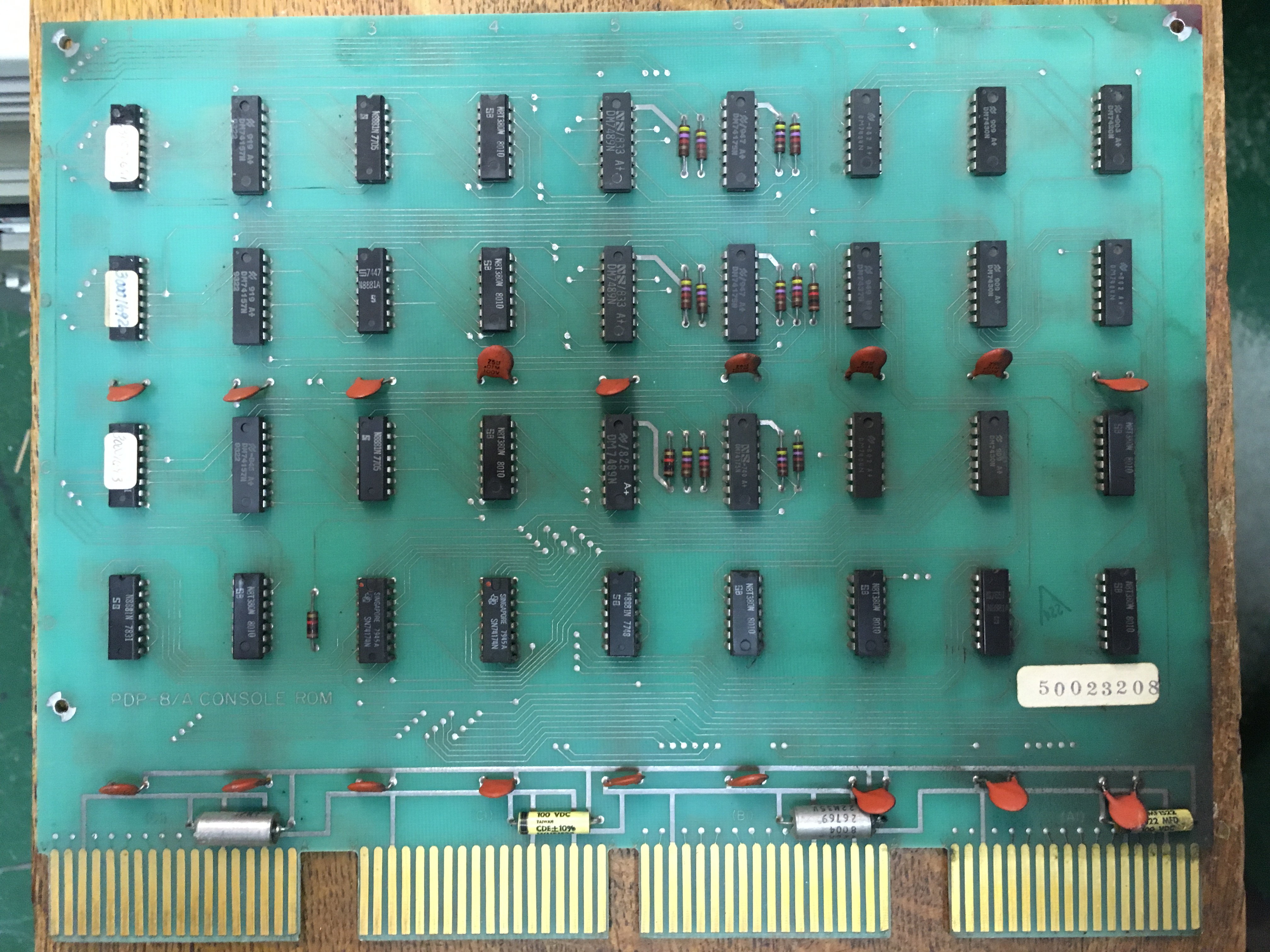
Hey all --
Got a PDP-8/A at VCFW this past weekend. It's an OEM model sans programmer
panel and was apparently used in a CNC application. It contains a board
I'm trying to ID. It says "PDP-8/A CONSOLE ROM" on it and has no other
identifying marks other than a logo on the back. See the pictures here:
http://yahozna.dyndns.org/scratch/pdp-8/8aconsole1.jpghttp://yahozna.dyndns.org/scratch/pdp-8/8aconsole2.jpg
<http://yahozna.dyndns.org/scratch/pdp-8/8aconsole1.jpg>
None of the braintrust at VCF were able to identify this mark. I'd guess
that the board provides a simple ODT interface or something similar. The
three ICs in the upper-left with the handwritten labels are 82S129 256x4
bipolar PROMs. They're not socketed so I haven't read them in yet. The
8/A's gonna need some TLC before I dare power it on...
I'm mostly curious if anyone can ID the logo -- it would be interesting to
know who made this thing.
Thanks!
Josh
I bought an ADM-3A on ebay. The monitor and the circuit board/keyboard are
>from two different terminals - confirmed by hand-engraved serial numbers on
the halves that don't match.
Not to mention the two different case colors (pale blue top, blue bottom)!
But it does have the lower-case option already installed :)
Anyhow, there appears to be some breakdown of the CRT implosion plate
silicone (screen rot). I've read about this problem before, so no real
surprise
It seems to be turning into brown "goop" which has run down onto the circuit
board.
Do I need to remove the goop before powering it up? Or is it nonconductive
and hopefully noncorrosive, so it can wait until I remove the implosion
plate and fix it?
thanks
Charles
---
This email has been checked for viruses by Avast antivirus software.
https://www.avast.com/antivirus
https://mvsevm.fsf.net
Currently, the TOPS-10 guest account (42,42) and the Unix v7 account dmr have no passwords.
Please treat the dmr account respectfully.
I will get to account requests?eventually, probably. TImeliness is not guaranteed. All systems are hosted on Raspberry Pis (the 36-bit ones on a Pi 3B+ and the 16-bit and 32-bit ones on a Pi 2B+) on Debian Buster. Absolutely no guarantee of availability or usability is made.
Adam
I am being offered some sealed Sun memory modules, PN 501-3050. These are
512MB compatible with:
* Compatible with Sun Blade 1000 with 600MHz CPU, 1000 with 750MHz
CPU, 1000 with 900MHz CPU, Blade 1000 Workstation, 2000 Blade 2000 with
900MHz CPU, Blade 2000 with 1.015GHz CPU, Blade 2000 with 1.05GHz CPU, Blade
2000 with 1.2GHz CPU, Blade 2000 Workstation, Fire 12K with CPU 900MHz, Fire
12K with CPU 1.05GHz, Fire 12K with CPU 1.2GHz, Fire 15K with CPU 900MHz,
Fire 15K with CPU 1.05GHz, Fire 15K with CPU 1.2GHz, Sun Fire E20K, Fire
E25K, 280R (A35), 3800, 4800 (750MHz), 4810, 6800, Netra 20 (N28).
Apparently they must be installed in sets of 4. Is anyone interested in
these?
Cindy Croxton
Electronics Plus
1613 Water Street
Kerrville, TX 78028
830-370-3239 cell
sales at elecplus.com
---
This email has been checked for viruses by Avast antivirus software.
https://www.avast.com/antivirus
>
> The same is true for the HP 7970B tape drives, I even have a 9-track 7970B
> that can be switched between 200, 556 and 800 bpi. I only need a 7-track
> head...
>
> Christian
>
The DEC TU20 tape drive is an HP 7975A 200, 556, and 800 BPI transport with
additional electronics to to connect it to the DEC tape drive bus.
--
Michael Thompson
Before VCF West 2019 becomes too much of a pleasant memory ...
We'd like to hear from you! This should take less than two minutes:
http://vcfed.org/vcf-survey
Tell us what we did well and where we need improvement. Or contact me
directly. We're not fussy, and we want to do better at our future events.
Mike
> From: Paul Anderson
> $325??
Well, they did list it with a 'Best Offer'. I figure the third time they get
an offer of US$100 (or whatever the thing is actually worth, I don't track
PDP-8 board values), it might become clear to them that they are way
optimistic on the value.
I once had to wait a year for an eBay seller to come down to a semi-reasonable
price on some RK05 drives... Eventually they gave in.
Noel
>
> thanks a lot for your hint to the DEC controller. I wasn't aware that the
> TM11, TMA11 and TMB11 controllers can handle 9-track as well as 7-track
> NRZI-encoded tape drives. However, all these controllers seem to be very
> rare in the public out there. Not too surprising considering that DEC TU
> and TS tape drives themselves are rare and that 7-track tape drives were
> soon replaced by 9-track tape technology in the early days.
>
> With best regards,
> Pierre
>
The TC58 Magnetic Tape Controller for the PDP-8 and the TC59 for the PDP-9
can be connected to both 7-track and 9-track drives. The TU20 drive on the
PDP-9 at the RICM is a 7-track drive. The only difference between the
7-track and 9-track versions of the TU20 is the tape head. All of the tape
drive electronics is the same for both versions.
--
Michael Thompson
I was referred to this group by dave.g4ugm at gmail.com who thought you
might be able to help me.
I need to punch a half-dozen datacards for an award for a retired
IBMer. Anyone know where I can find a working 026/029/129 within 300
miles of Raleigh, NC?
Many thanks for any pointers.
Chip Davis
chip at aresti.com
+1.919.271.2582
This item:
https://www.ebay.com/itm/133136230586
is poorly titled, so people's searches might not find it; the M8319 is a KL8A
4 channel EIA RS232 or 20mA current loop serial hex I/O card for the PDP-8/A.
Noel
We can at last announce our speaker roster for this year's Vintage
Computer Festival Midwest. I think we've got some strong topics and
great variety this year, and even a little space to give Trixter a
break from the A/V console. Check it out - and don't miss the cool new
speaker bios page - click a speaker's name to read a bit about them:
http://vcfmw.org/talks.html
39 days to go!
-j