Anyone have a use for this? It is a memory expansion board of some kind
>from a Netserver LX PRO.
It has sixteen 72 pin SIMM slots. Not populated.
HP D4262-60009
Free for cost of shipping from 78759
Jeff Walther
Forwarded from the Greenkeys list.
Looks like an interesting piece of test gear:
http://cgi.ebay.ca/ws/eBayISAPI.dll?ViewItem&item=370462778137
- John
From: "George B. Hutchison" <w7tty at olypen.com>
To: "Don Robert House" <Packard42 at gmail.com>,
<dhunter at islandregister.com>
References: <4D001215.31954.3F92DD3 at dhunter.islandregister.com>
<77B62C3F-03B0-47FD-8BC6-BFC1BF51B8DA at gmail.com>
Date: Wed, 8 Dec 2010 22:14:21 -0800
MIME-Version: 1.0
X-Priority: 3
X-MSMail-Priority: Normal
X-Mailer: Microsoft Outlook Express 6.00.2900.2180
X-MimeOLE: Produced By Microsoft MimeOLE V6.00.2900.2180
X-osmtp-outbound-sender: w7tty at olypen.com
X-osmtp-host: 65.243.191.51
X-osmtp-virus: clean
Cc: greenkeys at mailman.qth.net
Subject: Re: [GreenKeys] ATLANTIC RESEARCH DATA TECH DTS-1-M470/483
X-BeenThere: greenkeys at mailman.qth.net
X-Mailman-Version: 2.1.9
Precedence: list
List-Id: "Discussion of older radio teletype \(RTTY\) gear "
<greenkeys.mailman.qth.net>
List-Unsubscribe: <http://mailman.qth.net/mailman/listinfo/greenkeys>,
<mailto:greenkeys-request at mailman.qth.net?subject=unsubscribe>
List-Archive: <http://mailman.qth.net/pipermail/greenkeys>
List-Post: <mailto:greenkeys at mailman.qth.net>
List-Help: <mailto:greenkeys-request at mailman.qth.net?subject=help>
List-Subscribe: <http://mailman.qth.net/mailman/listinfo/greenkeys>,
<mailto:greenkeys-request at mailman.qth.net?subject=subscribe>
Content-Type: text/plain; charset="us-ascii"
Content-Transfer-Encoding: 7bit
Sender: greenkeys-bounces at mailman.qth.net
Errors-To: greenkeys-bounces at mailman.qth.net
X-Spam-Status: No, score=-2.6
X-Spam-Score: -25
X-Spam-Bar: --
X-Spam-Flag: NO
That unit was one of the standard pieces of test equipment issued to all RCA
Service Company Data Comm Techs.
When RCA succumbed to GE, a lot of them just disappeared.
I still have mine and it still works like a champ.
If the manual didn't come with that one let me know and I'll haul my manual
down to UPS and have it scanned into a .pdf.
You can either use it as a loop keyer, or, if you need loop power, it will
provide that as well.
You can send distorted signals up to 44 per cent switched bias, and can
measure incoming bias and distortion as well.
I never left home without mine.
There is a built-in FOX generator that will do baudot, ASCII,
Teletypesetter, and EBCDIC. And you got a very good deal.
A friend of mine traded a new, unfired .45 ACP Match Grade pistol for one,
and both parties thought they got the better end of the deal.
The Beer Cooler Accessory was extra, but otherwise they were a repairman's
dream.
W7TTY
Hi all --
Got myself a Friden 1162 desktop calculator. This is from about 1968-69
and has a neat-O keen CRT display and uses a magnetorestrictive delay
line memory. Kinda cool.
Mine has taken a fair amount of abuse over the years, and is currently
not working properly -- at the moment it powers up (with nominal
voltages, etc) and displays a normal display of all zeros, but as soon
as a key is depressed, the screen goes blank and never returns.
The 1162 has a rather interesting keyboard encoding mechanism (you can
see a decent overview of the device & the keyboard mechanism here:
http://www.oldcalculatormuseum.com/friden1162.html) Close investigation
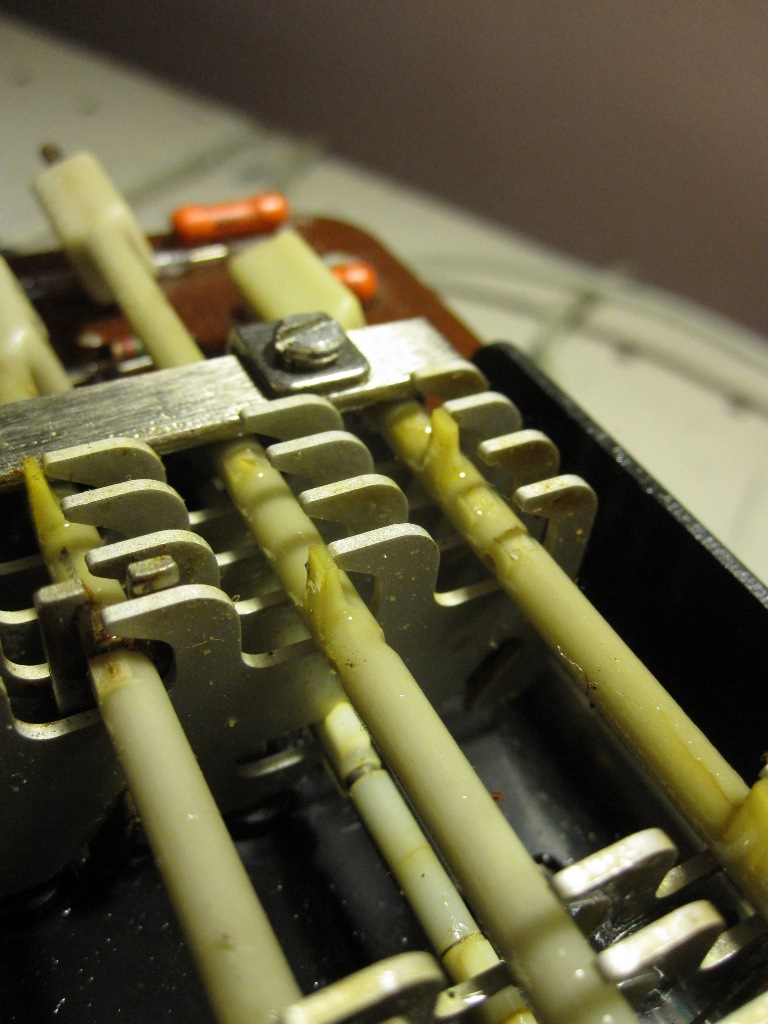
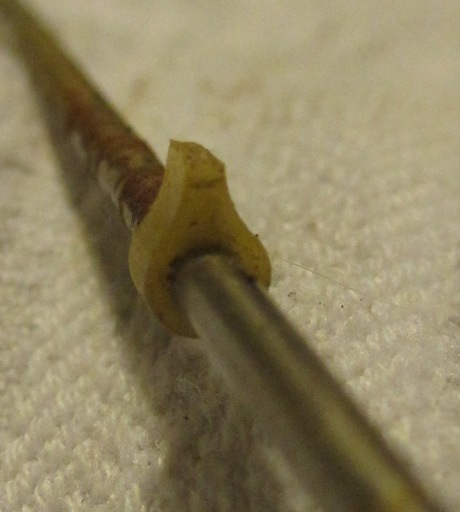
of the keyboard mechanism on my specimen reveals that a few of the
plastic "fingers" that are positioned on the rods that move the magnets
to/away from the reed switches have snapped off.
I have a close up picture of what the fingers are supposed to look like at:
http://yahozna.dyndns.org/scratch/friden/normal-finger.JPG
And a picture of one of the broken ones at:
http://yahozna.dyndns.org/scratch/friden/broken-finger.JPG
The broken fingers no longer make contact with the mechanism, and so a
couple of the reed switches do not get activated properly. I'm guessing
that this is at least part of the reason the machine is acting the way
that it is (that it's getting unexpected scancodes from the keyboard and
going off into the weeds...)
I need to figure out how to "recap" these fingers. I don't have a lot
of experience repairing plastic stuff like this, anyone have any
suggestions?
Thanks!
Josh
I still have some parts for the original LaserJet. If I recall
correctly, the engine was made by Canon and was also used in printers by
other manufacturers like QMS and Canon. I installed & maintained quite
a few of them.
As far as collecting printers, I still have a few that are small enough
to hold onto. I have a Kleinschmidt drum printer (1960's?) and an
Axiohm aluminized-thermal printer from the late 70's. I had to give up
all my Teletype's (ASR-33 and an older model) as well as a chain
printer, Printronix line printer, and a wet-process "laser" printer from
the early 70's (?) I think it was a Xerox. Just took up too much space.
They are all a part of history; I hope someone out there is holding onto
them.
Clay
---------------------------------------------------
Owned by a coworker of mine who says it still works fine.
He doesn't want to throw it out if there is someone
interested in preserving it. Somehow, I've never been
interested in adding printers to my collection. In the
"nostalgia era" of my computer experience, what I collect,
printers were noisy, messy and not worth the bother.
Anyway, if you want it and can arrange to pick it up fairly
quickly, let me know.
Bill
I was given a ZIP file that unpacks to two directories under MacOSX:
Diagnostic1
MacUser
All files are in pre-OSX "forked" format. I copied both resulting
subtrees to a netatalk server and tried to access them from a 68k mac. For
some reason, the second of these is visible under MacOS 7.x (tried several
values of 'x')!
The MacUser directory is fine - both data and resource forks are as
expected. However, no matter what I've tried 'Diagnostic1' simply does
not show up in the finder. I'm sure it's something basic, but I'm not
much of an ancient Mac guru.
Any ideas?
Steve
--
For some Computer History Museum work I need information on 7400 series Flip
Flops (S and Normal, DIPs) circa 1973 (anything 1970-75). Anyone have any
maximum clock speed and OEM volume pricing information on parts such as 7473
thru 79 or 74106-116?
I must be getting old because I remember the 7474 well but I thru out my
Yellow books years ago :-)
Thanks
Tom
I was contacted many months ago by folks in York PA about a large
TRS-80 Model II collection they need to get rid of.
This includes several CPUs, hard drives, software, manuals and so on.
Someone was supposed to collect this but has failed to do so and now
the gear is in jeopardy of being scrapped VERY soon.
If you can save all or part of this haul please contact me ASAP so I
can put you in touch with the owner.
This stuff should have been gone by the beginning of last month so
time is critical to save it.
--
Erik Klein
www.vintage-computer.comwww.vintage-computer.com/vcforum - The Vintage Computer Forums
marketplace.vintage-computer.com - The Vintage Computer and Gaming Marketplace
Hi! I made this offer at Vintage-Computer.com forums and got some response
so am also making the same offer on CCTALK. The following link is the
design I referring to:
http://n8vem-sbc.pbworks.com/w/browse/#view=ViewFolder¶m=SCSI2IDE
I am trying to decide what to do with the SCSI to IDE/SD project. I think it
would be a good and helpful thing to have but recognize it may be too
specific or overcome by events. If you are interested in buying a prototype
board please contact me at
mailto:LYNCHAJ at YAHOO.COM?subject=SCSI2IDE
If there are 5 people interested I can get a batch of five PCBs made for
$150 or $30 each. If there are 10 I think I can get the prototype board cost
reduced to around $20 each.
Please note if you buy a prototype board you don't have to actually build
and test it. You can buy a board and have it sent to a volunteer builder for
build and test.
If the SCSI2IDE project is to succeed we have to get past the prototype
board phase and into the hands of builders for coding. Obviously with
prototype boards there are no assurances and you can expect there will be
problems. We have to find those and fix them before a manufactured PCB is
even a possibility.
Thanks and have a nice day!
Andrew Lynch
Does anyone have experience or notes on the absolute minimum hardware to
do parallel narrow (and slow) SCSI.
Back in the early days, we were doing non arbitrated buses, and they are
now essentially unsupported, and there are some more bits related to
Attention that possibly has to be responded to quickly to keep from
upsetting initiator stacks. However I would think a small circuit
external to a small processor such as a PIC or AVR would allow one to
fool most initiators, and do a simple device with SCSI on one side, and
either ethernet or USB on the other, or even an SD ram part.
The reset signal has some real constraints about getting the drivers off
the bus really quickly, and that is one signal that can't be handled in
software unless you have really fast response. Also there are some
state transitions related to Reset that I think might have some issues.
You would of course need to latch that a reset occurred and when your
slow device got around to polling it it could handle that.
Also when the states are decoded would not be too hard to record and latch.
I just wonder if this would be less than the simple target circuits out
there and would be very difficult to implement.
The messaging and selection added some logic I have not studied in a
long time such that there were some transitions that could not be easily
handled either.
Jim
I recently acquired an HP 87 that I was able to repair, all except for a
few sticking keys. From digging through the archives at this site and
the HP-80 Series sites it seems the only way people have found to fix
these is to cannibalize the plungers from other similar keyboards. Has
anyone figured out a way to repair these cracked key plungers yet? I
have tried a few things like gluing and wrapping and melting, etc, with
little success. Does anyone know a source for these plungers? The HP
part number 1535-4043 still comes up on HP parts site with no stock.
Clay